Needed text

I am still not quite sure what I think about Jimmy Corrigan – an uneasiness, confusion, and trying to piece it all together.  Like others posted I was grateful for the summary in the beginning of the book to offer some clarification and a and break from the steady stream of consciousness.  But when looking back through to write the blog the first thing I did was to compare Jimmy Corrigan to Nat Turner and I primarily was struck by the text of Ware’s novel, which offers a great contrast to Baker’s novel.  Nat Turner relied almost entirely on the power of the imagery with only the few blurbs from Turner’s confession, whereas Jimmy Corrigan relies heavily on its text.  Without the text and dialogue of the novel I would have never been able to piece together the story or even come close to the dialogue Ware presents.  Obviously as a graphic novel the images play a vital role in the comprehension and interpretation of the book, but I think that more than any of the other graphic novels we have read thus far Ware’s offers an equal role between the illustration and text.  The heavy reliance of the images upon the text stands out for me in simply following the images.  When there are no arrows to tell me which image to read next I piece it together by piecing together the text.

The heaviness of the text that I feel throughout the text I think feels more prominent because of the silent, withdrawn, awkward character of Jimmy Corrigan.  Plus the images must be read like a sentence more than I felt with the other novels.  The breakdown of the panel into the small squares creates a choppy sentence of pictures that I must read slowly along with the text.  In the other novels I did not feel as if I was ‘reading’ the images exactly but more taking in the elements of the illustrations, this time I feel that I moved slower through the novel because of the intricate interplay between the text and illustrations.

Sorry this is a little jumbled; I am confusing myself now trying to navigate through my navigation.  I hope this makes a little sense.

An introduction or a warning?

Well done earlier posters on getting to some of the big issues early. As a result, I’m going to focus on one aspect of Jimmy Corrigan I found fascinating (but probably wouldn’t have blogged on as a first choice): the introduction.

Perhaps it’s better referred to as a primer than an introduction. Or an introduction to reading comics. Either way, Ware’s playfulness in this section actually helps reveal a lot about the text as a whole. His intricate and elegant language (especially in the third section, as Lars mentioned on twitter) help set a tone oft-repeated (and drawn) throughout the book. And just as importantly, his primer to comics, including the “how to read these/do you see a mouse or just lines in the box” section and the short quiz, help reveal his expectations of his readers, and some preconceptions that permeate the comic world.

On a side note, another reason I’m compelled to work with the introduction this week: no page numbers.

Jared’s directions to find the text he’s referencing in this week’s post:

1. Open front cover. 2. Stop.

If you’re like me, maybe you skipped over what looked to be a silly part of the book and just dove right into the text. If you’re like me, you may have found yourself gloriously lost by about page 30 and decided that perhaps returning to the introduction might help sort things out. In my experience, the introduction was not nearly as helpful as the first and only recap when it came to making sense of the multiple threads in JC, but the introduction was still an interesting and informative read that bears heavily on the remainder of the text.

Ware starts by outlining a brief history of visual storytelling, much like we did our first week in class. One thing I think this does is open the table for the possibilities that come with telling stories with pictures. Cavemen did it one way, paintings of the Renaissance another, and “comic books” still another. Looking back on this now, it’s almost as if Ware is spelling out a warning: this will not be like any other “comic book” you have read. And Jimmy Corrigan isn’t like any other comic book I’ve read. Panels only sometimes have a clearly defined direction, thanks to the arrows, and as others have mentioned, dreams, past stories and the present story form an interwoven story that can get really confusing. Like Ulysses confusing.

Moving on to section 2, Ease of Use, we begin to see even more of the funny tone Ware brings. Here the ease of use has nothing to do with reading (which he handles in general instructions), but the ease of portability, and convenience to transport and read the book as you please. But this does not mean this will be an easy book to read, just an easy book to carry around and read as you wait. When it comes to the actual reading experience, it’s best to read the first line of the introduction:

“While it was not the intention of the author of this publication to produce a work which would in any way be considered “difficult,” “obscure,” or, even worse, “impenetrable,” it has come to the attention of our research faculty that some readers, owing to an (entirely excusable) unfamiliarity with certain trends and fads which flow through the tributaries of today’s ” cutting-edge culture,” might not be suitably equipped to sustain a successful linguistic relationship with the pictographic theater it offers.” Again, it’s important to remember the tongue-in-cheek nature of this entire piece, but at the same time to recognize some of the kernals of truth he drops. I’m somewhat familiar with comics, but my ‘linguistic relationship’ with this ‘pictographic theater’ was frequently strained, rarely sustained. Thanks for the warning, Ware. I just wish I’d taken it more to heart. In this sense, JC is easy to use (as a book is used), but not easy to comprehend/follow. At least not without a lot of work.

I will move on to the third section now, then leave sections 4 and 5 open for comments since they also help reveal some of the themes and difficulties presented in JC.

My only note for Section 3, “Role,” is scribbled at the top of the page. It reads: “awesome.” No, this note is not very deep, nor is it very scholarly. In my defense there’s not a lot of room for notes here, and I dislike the notion of writing in any graphic novel, even if it’s just the introduction. This section blew me away. It was more than just hilarious, profound writing as the importance of a line such as: “As such, the thinking person would have to conclude that, in general, the seeking of of emotional empathy in art is essentially a fool-hardy pursuit, better left to the intellectually weak, or to the ugly, for they have nothing else with which to occupy themselves. Besides, it is unsightly to feel sorry for oneself, and such ‘unfortunate times’ eventually pass, anyway, and if they don’t, then mercifully, for the rest of us at least, suicide is, of course, an option.”

This one line is incredibly loaded, and has implications for our entire reading. Is Ware talking about himself here? We know Jimmy is somewhat based on him, and this line seems to directly reference the lonely, sad, pathetic, passive, ugly, intellectually weak main character in the novel. Jimmy frequently feels sorry for himself, or at least that’s how I’ve read his character, and that is unsightly. At least there’s always suicide. At the same time, though, some of my previous tongue-in-cheek questions come back into play in this section. I don’t think it’s complete farce, but I also don’t think Ware intends us to take it as fact. It falls somewhere in between, and I’m still trying to understand how, exactly, I should be reading this.

For example, Ware writes that emotional empathy is a foolhardy pursuit.  Now, as far as Jimmy Corrigan goes, I agree. I can’t empathize with this character, and after a point I stopped trying and just started enjoying the interesting way he goes about creating a comic narrative. But I can’t say this is the case for 99% of the other fiction I’ve read. Any good writer knows that if you don’t have a character people can relate to (think empathize with), then you don’t really have a good story. That’s not to call Ware a bad writer, he just fits into the echelon of folks who buck the rules, and somehow make it work anyway. They’re a class all their own. Does he know this? I feel like he must, and that’s what gets us some of the lines in the introduction.

Only after reading a good amount of JC and returning to the introduction could I really see some of the hints and warnings Ware drops both the experienced and inexperienced comic reader about reading his text. This helps make it hilarious, but also seems to reveal some of the aspects Ware was more than aware of (and there’s a pun)  when constructing the book. So, now I leave it to you as my word count just keeps increasing:

Is Section 4 another warning, but this one for non-comics readers? Or is it just another joke? What else does it tell us about our reading?

Oh Section 5, how I loathed you–or how you made me loathe myself? Anybody else notice the sexism (or at the very least gender bias) that comes after question 1. “Are you male or female? (if b [female], you may stop. Put down your booklet. All others continue”?

Or is he getting at something else here? Like perhaps that a female comic fan wouldn’t have any of these issues of self-hatred and distant daddies that apparently all comic fans (or maybe just Ware himself) have? What does the instruction that women not take the test mean?
A World Without Faces

As I think  has been pointed out already, Jimmy Corrigan is a very densely illustrated novel. There a many recurring visual themes and motifs that Chris Ware uses to various ends. Jared and Lars have already pointed out several including the shifts in the perspective distance. One thing that struck me as part of these visuals was the distinct lack of faces on non-Corrigan characters. Not even all of the Corrigan characters have faces.

We are given occasional faces, like Dr. Wilson and a few others, but more often than not the panels are arranged in such a way that you don’t ever really see the faces of other characters. You never see modern-Jimmy’s mother’s face at all, only the photo of her where she is turning away slightly from the camera. Often the faces are off-panel but they are frequently obscured by other objects or even by text balloons. So why don’t we get to see these faces?

I think there are multiple reasons, or potential reasons, for this visual motif. I think first and foremost it is part of Ware’s construction of this/these characters as isolated and distant from one another. These people are all unable to connect to one another and so everyone becomes just another faceless person. People are essentially just other objects.

Additionally, I think this motif is part of Jimmy’s character. Modern-Jimmy is socially awkward to the nth degree. Each panel with him is like a full episode of The Office. He is unable to really connect with anyone and is petrified of the very idea. He is incapable of dealing with the world outside of his imagination (and he isn’t even all that in control of that). But more than the awkwardness is his infantalization. He is a child in many ways and therefore doesn’t see people on an equal level, but must look lower down or away. I’m reminded of other comics or cartoons focused around children where adults are never depicted or are only shown from the knee down, like in Peanuts or Muppet Babies. Modern-Jimmy is an awkward man-child, while Past-Jimmy is an actual child, and the lack of faces seems to be a way of communicating that child perspective.

The Subjective Portrayal of Passing Time

Chris Ware’s Jimmy Corrigan: The Smartest Kid on Earth wonderfully plays on the ideas of perspective, objectivity, and subjectivity, as well as the author’s and audience’s distance to the story and its characters (as Bedehoft argues, using the “cut-outs” in the text as examples), to emphasize how one’s experience of passing time is often interrupted and affected by history, memory, and fantasy. In Jimmy Corrigan, these interruptions make up a significant portion of the text, suggesting that Ware sees time not only as the passing of seconds, minutes, hours, and days, but as the moments we daydream staring out the window, thinking back upon our past experiences, worrying about our futures, fantasizing about opportunities that await, wincing at embarrassments from adolescence, dreading horrors lurking in the shadows of an unknowable future, and so on. Time not only passes Jimmy by, but is filtered through him — the minutes can pass slowly and awkwardly, with other characters trying to engage the socially inept Corrigan, or these minutes can seem like hours in which robots watch their younger selves from the deck of airship, only to wake and shed their metal plating (and in this moment between dreaming and waking, being next to a peach tree and under a bird, with peaches and birds being two of the numerous leitmotifs Ware uses throughout Jimmy Corrigan) on an airplane headed towards Michigan to meet an unknown father.

As Bredehoft notes in his essay “Comics Architecture, Multidimensionality, and Time…,” the historian Hayden White “describes one of the central understandings of contemporary historiography as suggesting that ‘events must be not only registered within the chronological framework of their original occurrence but narrated as well, that is to say, revealed as possessing a structure, an order of meaning, that they do not possess as mere sequence” (Bredehoft 886).

The actual narrative of the contemporary Jimmy in Jimmy Corrigan could be easily laid out, revealing a tragic tale of a shy, emotionally stunted man meeting his father for the first time in adult life, laying the first tentative foundations of a relationship with his adopted half-sister, only for his father to die as the result of a car accident and his half-sister literally pushing him away in a moment of suffocating grief. But Ware does not present this story alone — instead, Jimmy, who is almost incapable of expressing/presenting himself (or the ‘order of meaning’ of the passing events that make up his life) in his own words, is expressed/presented through his dreams, daydreams, nightmares, and imaginative currents. In many ways, Jimmy Corrigan‘s narrative and pictorial presentation are indebted to works like Marcel Proust’s À la recherche du temps perdu and Virginia Woolf’s Mrs. Dalloway, where the present is constantly interrupted, diverted, colored by and juxtaposed to past recollections and daydreams. In these works, time is never transcended, but is presented as subjectively malleable — a watched pot never boils, as my mother used to say to me.

Instead of presenting the passing moments of time between when the oven is turned on the water boils within a pot — be it the life of the younger or older Jimmy Corrigan — Ware allows us a glimpse inside of their imaginations, dreams, and nightmares, the interruptions that fill their heads as the water heats up, and demonstrates, as Bredehoft points out in his essay, how time and history unknowingly connects the characters, as when “Jimmy unknowingly looks through a window installed by his own great-grandfather, literally inhabiting a space once filled by his ancestors” (879), or pictorially represented in the history of the torn photograph Jimmy keeps in a drawer — a page which not only seems to condenses time and history, and demonstrates how the past is always entwined in the present, but interestingly links Jimmy’s window frame with a billboard outside, connecting Jimmy’s (lonely) home and existence with that of the city outside, even as it retreats from the wider shot of the city into the deadening emptiness of Jimmy’s home (877).

History and the Mundane in Jimmy Corrigan

Wow – there’s a lot going on in Jimmy Corrigan.  I really enjoyed the text, but with so many different themes, visual motifs, and parallel story lines – I’m sure this is a graphic novel where one constantly discovers new things on subsequent readings.  But one really strong impression the text left with me is the sense that history is all-pervasive, even in the most mundane aspects of life. 

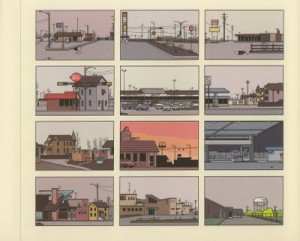
Jimmy’s convoluted family history is at the center of the text, and the sections on Grandpa Jimmy’s childhood give readers a direct view into Chicago’s history and the World’s Fair.  But throughout the story, the more mundane aspects of everyday life also seem to be loaded with history.  The page about halfway through the text, with twelve panels of restaurants, stores, gas stations, etc. seemed to really hit on this idea.  The blurbs on the back of each image provide a roundabout history of Waukosha.  And while the images on the front panel are universally stark and depressing, the titles on the reverse of each panel are comically ironic.  The disconnect between the written words on the back of the page, and the images seems to serve as a commentary from Ware on our ability to distort history to make even the most mundane situations seem note worthy.

The veiled reference to Amy in the blurb on the reverse of the Pam’s Wagon Wheel panel directly connects Jimmy’s own story and familial history with the more general overview of the history of Waukosha.  This connection is seemingly reinforced with the scene directly following the “History of Waukosha” page, in which Jimmy and his father are also dining at Pam’s Wagon Wheel. 

I found this dining sequence between Jimmy and his father to be one of the most fascinating moments of the entire text.  Ware’s tactic of continually returning to the image of the table, with its changing dynamic of food, cups, and discarded wrappers was especially interesting.  The people responsible for creating the changes we see on the table (Jimmy, his dad, the waitress) are never seen in any of these panels.  It’s intriguing that during a moment of such seemingly intense personal drama for Jimmy and his father, Ware always circles back to the mundane image of the table.  The sequence of images for the table is cyclical – it starts with the uneaten food and dirty place setting of the previous customers, then shifts to a clean table, then slowly adds cups and food until it ends where it began, with uneaten food and dirty place settings.  Perhaps the focus on the mundane in this scene is meant to comment on the cyclical nature of history.  In a weird way, by acting as a visual contrast with the awkward conversation between Jimmy and his father, the image seems to reinforce the overall sense of alienation that pervades much of the story, further shattering any idealized notions of family life or father-son relations.

John

The Saddest Kid On Earth

I think Ware is commenting generally on the dysfunction that can run in families and that seems, at least to my reading of the book, to be come more pronounced as the generations of Corrigans moves from a simple, rural Illinois to a complex and modern Chicago. Both fathers and mothers seem inept at life.   Desperate, at times needy, and definitely lonely, you don’t wonder why; they all seem self-centered and incapable of sharing themselves with anyone.

We have four generations of non-achieving, not-so-bright men, running the gamut from abusive and sexually maladjusted to quivering, indecisive stutters. Pathetic might be one word to describe Jimmy Corrigan as a whole, but looking at the generations of Corrigan men over time, they are cruel, sadistic, bigoted, and unloving as well as socially maladroit, clumsy, and, ultimately, sad.  Jimmy is so perplexed by genuine emotions that he doesn’t know them when he experiences them; abandoning his step sister as she reacts to her father’s death, he doesn’t realize the sense of loss she feels for what it is until he cries in a cab heading home alone.

Jimmy’s mother seems to be not much better.  Sexually indiscriminate, maybe out of loneliness or desperation, she plays Jimmy throughout the book, taking out her dislike for his father and her own existence by keeping him so attached to her that he has no life of his own.  Until, in the end, when she needs him no longer, she pushes him out to be replaced by a new man. No surprise that Jimmy escapes into fantasy.  One wonders how often this has happened to him in the past.  To the Corrigan men, women in general are as confusing and cruel as the red-headed school girl who taunts his grandfather.

The city of Chicago also undergoes a transformation as we move through this history of Jimmy’s ancestors.  Ware’s flashbacks, at times confusing, take us from a more bucolic and simpler city in the past, to a depressingly dark place where Jimmy goes through the motions.  The rain and snow never seem to end in his life and the dark canyons become a metaphor for the Corrigans.

While Jimmy is the product of this dysfunctional genetic line, Ware shows us, through his adopted step sister Amy, that there are those who do not give up and let the world beat them down.  We don’t see much of her, but she shows compassion for Jimmy and love for his father.  Listening to him talk about his life, she seems to realize that nobody has cared for him before.  She explains to him that spelling “HI” with bacon strips is his fathers way of expressing affection and seems to understand the disconnection he feels.

In the end, one hopes that Jimmy is not successful with his new office mate.  The thought of more Corrigan males is too depressing to contemplate.  While I enjoyed reading Jimmy Corrigan – The Smartest Kid On Earth, it is best if this Corrigan is the last of the line.

Uneasiness (Jimmy Corrigan)

Ware’s Jimmy Corrigan strikes me as an experiment in self-loathing and an exercise in writing a comic book to make the reader as uneasy as possible.

First, the strange embodiment of time creates uneasiness because we’re constantly going back and forth between the present reality, the present fantasies/nightmares, and the past without any obvious markers for having done so. I was grateful for the first and only summarization of events which I cannot give page numbers for because they are not included in the book and I think it’s contrary to the author’s purpose to try to count them.

Which brings me to a question – why are there no page numbers?  What purpose does it serve to never let the reader know where they are in the book?  I think it adds a layer to the already intricate storyline by leaving the reader always a little uneasy.  We never really know where we are in the story, or even really what the story is until very late in the graphic novel.  In terms of the panel format, it seems that Ware is purposely consistently changing it and on top of that the font also changes size making it very difficult to not pay close attention to where you are on the page.  I was grateful for the little arrows giving me some direction, but it still made me uneasy to have to figure it out anew for every page.

The protagonist was my biggest problem.  Because the protagonist harbors no typical hero quality I found myself constantly looking for some redeeming characteristic.  Although it could be argued that wanting to be liked fits into that category, I would argue that it is specifically this trait that makes Jimmy so unbearable, spineless and empty.  He has no sense of self worth.  But I don’t think we’re really supposed to like him.  He is the alter-ego that nobody wants to admit (and of course I am certainly not doing that here), the victim who cannot be anything other than that.

On a separate, but maybe relevant note, I think the grandfather’s story of physical and emotional abuse could easily be Jimmy’s story and I think Ware is again playing with a sense of time and order.  Although Jimmy did not know his grandfather’s story it seems that he is, personality-wise, a direct descendant of that history.  This places him even more firmly in the victim role, but because it wasn’t him I find it even more difficult to like Jimmy.

A Fresh Perspective Please – Travis


I have to admit, I was not looking forward to reading this novel from the moment I saw it on the syllabus and the completion of the task did not alleviate any expected feelings or thoughts.  I guess I agree with Kacy in my inability to share Kyle’s enthusiasm with the material, most probably because I heard the story (and many many like it) growing up all my childhood and then learned of the events (albeit from a more academic slant) in school.  Much like Maus, having a fair amount of knowledge on the history of Nat Turner, I found myself looking for a fresh perspective to the account, something to provide a different interpretation of the tragic events; in this, Kyle Baker failed me.

Graphic Novel indeed.  Baker’s use of images to depict the story was perhaps the only thing fresh to me, however, I have seen my fair share of slave images.  It makes me wonder as to the intended audience of Nat Turner, and the intended reception/experience of the reader. I am far from numb to the history of slavery, but did Kyle Baker truly use a book laden with images to create a greater response than words?  I am so thankful that I purchased a used book in which someone wrote down the notes of the pages from the back on the pages to describe the action depicted in the images; I found myself spending more time than intended trying to decipher a large number of the images and some of them were simply too confusing in artwork for me to grasp. 

I don’t think anyone can call Nat Turner a superhero (seriously…it makes me laugh), or a hero in my opinion. Of course, that’s just my humble opinion; I merely mentioned the name to my Uncle Sunday evening and he looks up from his work to ask, “The Civil Rights Leader?”  I could only laugh.  I don’t think anyone would read Kyle Baker’s Nat Turner and feel they were engaged with the story of a Civil Rights Leader, but, like all things, you could call it a matter of perspective.  Nat Turner was violent; so were the actions of the rebellion.  Nat Turner attempted to depict the horrors of slavery; I can’t think of a collegiate audience foreign to it’s knowledge.  I just could not find a fresh perspective from Nat Turner, and this created a large abyss in my ability to appreciate the work.

Nat Turner Jumble

I feel like there is a lot to talk about with this book, and many of the previous posts have touched on a lot of those issues, so I don’t necessarily want to rehash, but my thoughts on the piece are kind of all over the place. I’m going to throw them down and maybe I’ll be able to make sense of them.

Messiah or Madman?

I’m not entirely sure where Baker’s work falls on this issues. As has been noted before, he claims Nat Turner as a personal hero, but then shows Turner doing some very troubling things. I will be the first to admit that you don’t have to agree with 100% with the actions or beliefs of a personal hero (for example, I count Theodore Roosevelt as a big hero of mine and think he is an admirable man, but he was responsible for some pretty unpleasant things, like the ripping-off of the Panamanians or his blood-thirsty desire to start war with Spain), but there does seem to be a bit of a disconnect in Baker’s hero worship. Turner is displayed as messianic and is drawn to look very heroic, but he makes some very un-messianic choices, like the decision to go back to kill the baby in the cradle. Baker seems to acknowledge this disparity of character by making the depictions of violence increasingly brutal, and the images of the rebels as increasingly grotesque, yet Turner himself retains his look of nobility. There’s almost a sense that Baker is distancing Turner from the most barbaric acts (which fits with the Confessions themselves).

Blurbs

I found the blurbs on the back of the book (as well as the description on the inside jacket) to be very interesting in hindsight. Several of these items state basically the same thing: “This book chillingly illustrates the horrors of the slave trade.” Now, the book certainly does expose some of the horrors of slavery and the slave trade, and rightfully so, but these are not the atrocities that cling to my mind at the end of the book. When I put down Nat Turner, I still have visions of Will, in monstrous hulking mass, brutally hacking people (including children) to death. By the end of the book, I’m not thinking about the horrors of slavery, but the horrors of the actions of the rebels. Perhaps this is Baker’s way of depicting that violence begets violence, and that oppression begets insurrection, but it seemed incongruous to read these blurbs upon closing the book.

Depictions of Characters

We’ve touched on some of this a bit already. It seems pretty clear that as the violence continues the rebels become more grotesque (particularly Will), but there were some other things I noticed.

To begin with, as I hinted at above, Nat Turner has a very Christ-like countenance, especially in the final chapter. This obviously plays to the messianic role he is cast in, but it seemed to me at odds with the  lithograph portrait of Nat Turner http://www2.lib.virginia.edu/small/collections/southampton/NatTurnerRebellionPhotos/image/item1.jpg. However, I later found this engraving of Turner’s capture http://en.wikipedia.org/wiki/File:Nat_Turner_captured.jpg which seemed more likely the primary source of Baker’s illustration. Of course this later engraving would have been made some time after Turner’s capture, since the artist wasn’t born until nine years after Turner’s death.

Another thing I noticed, which seemed to add commentary to the images (commentary without words obviously) was Baker’s portrayal of many of the other slaves. As the rebellion continues, the rebels continue to drink heavily. These slaves seem to be depicted almost cartoonishly (pp. 143 and 157), and the implication seems to be that the rebellion might have succeeded had it not been for these slaves.

Additionally, the slaves that side with the owners and warn them of the rebellion are drawn as  caricatures of the Uncle Tom/Minstrel-type (pp. 130, 132, 136). By using these types of stereotypical and  cartoonish depictions of those not on the side of the rebellion, Baker is clearly labeling them as the enemy. These cartoonish figures call to mind the worst of the racist depictions of black people in the Stepin Fetchit tradition. These characters seem completely out of place in the otherwise serious depictions of the book.

Conclusion?

I guess I’m not sure where I stand on this book, or even where Baker stands. I think in general the book is masterfully done, but I’m left with a general sense of ambivalence. I found the book compelling and thought provoking and I thought the art was beautifully rendered, but was left somewhat empty by the experience.

Will

One thing I found interesting as I read through “Nat Turner” was Kyle Baker’s use of stock types and situations to fill in the gaps left in the sparse narrative which makes up “The Confessions of Nat Turner.” From the beginning, when he posits the origins of Turner’s mother in a narrative conflating many stories of African slave raids (reminding me of a much more violent version of the Newberry award winning children’s novel “Amos Fortune, Free Man”), to the end, where lens flares halo around the martyred Turner’s head as the grotesquely evil crowd (gap toothed girl, apple-chewing woman, and slavering man included at no extra charge) is struck dumb at their own sin, tropes abound in Baker’s construction.

The trope I found most powerful and simultaneously most disturbing, however, was the figure of Will – the most violent and strongest of Turner’s original band. In the original text, he is mentioned as saying “his life was worth no more than others, and his liberty as dear to him. I asked him if he thought to obtain it? He said he would, or loose his life.” Additionally, Turner (in Gray’s words) attributes the first and largest individual number of deaths to Will. From these clues, Baker builds up the character of the brute, a man of generally sunny disposition who wholeheartedly gives in to the frenzy of killing when roused, and at the last gasp is still the most fearsome of the rebel slaves.

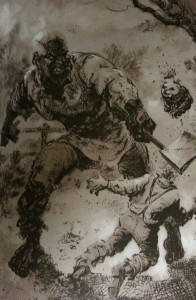
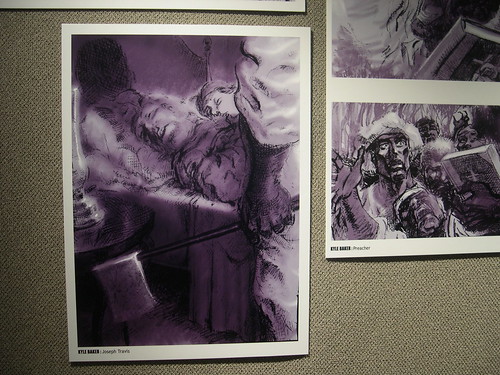
Starting with chapter III: Freedom, Will takes an arresting role. The sunny side of his nature appears as he chops wood and waves to a smiling tiny boy, though Baker utilizes image-juxtaposition with the axe in the forground of the smiling white boy as a stock situation of foreshadowing, creating a kind of sick tension. As Turner begins his rebellion with a failed hatchet swing and his first victims awake, a now-hat-wearing Will is the first to strike, revealing Baker’s conception of Will as Turner’s lieutenant. From there on, Will proves himself the most effective, ruthless, and perseverant of Turner’s men – volunteering to kill the forgotten infant, and then most iconically (because it occurs in a splash page) backhanding the little boy’s head off cleanly as the child runs smiling towards him.

The horror of this image is that which militates most strongly in Baker’s favor for me. I detest the sentimentalized description of Turner as a superhero in the preface, am rather sickened by the caricatures and martyr-images of the final scene, and unconvinced by the “literacy” message of the opening and closing images. But here, Will presents a character of great complexity. What he does is clearly absolutely evil – though the child would no doubt grow up to be as horribly exploitative an owner as his parents, he currently loves the slaves and trusts them, making Will’s action that much more horrible. And yet Will remains somewhat admirable, both because of his sunny initial appearance, and his dramtically fitting exit, rising from his apparent death and facing a circle of rifles with bared teeth. This final scene struck me as very Frank Miller-esque, reminding one of Batman rising from his beating at the hands of the mutant leader.

In the end, I am mostly unmoved and frustrated by Baker’s work in “Nat Turner,” but in his conception of Will I see the strength of his manipulation of familiar figures and circumstances, bringing out both the evil and the good of the rebellion in a nuanced way.

Picture’s worth a thousand

Many people have discussed the role of Nat Turner as a hero, the biblical references, and other aspects of character and storytelling. You beat me to it, so now I’m left wondering how to talk about a text that doesn’t even (really) talk itself. A strong lack of words, save for the occasional diary entry, place most of the storytelling work on pictures. That’s not to say pictures aren’t capable of such an endeavor, they do so all the time in children’s books. But this is a different monster entirely, and as a text that drives home important themes on slavery, morality, literacy, and human nature, it must work harder than the average children’s book. I felt compelled in particular by the way Baker uses revelation of information to help keep my attention high, despite the lack of words.

As I read, I found I frequently asked myself, “wait, what just happened?” One way Baker weaves his stories–while also helping keep readers focused on the story, despite its lack of words–is through his revelation of information, which often sends the reader back several pages to understand exactly “what just happened.” This technique shows up early on and continues through much of the book, though I noticed it does taper off a bit as the violence gets extreme, since the violence becomes the story. When the story opens we see a lot of people living somewhere. Their dress and setting don’t resemble that of a plantation, but I’ll admit I didn’t notice this at first (11–13). When we see the images on 14 and 15, of horses with guns charging in, an immediate sense of time and place comes into the pages. We’re most likely in Africa during a slave raid. After realizing this, I immediately flip back to the beginning to see what I missed, and notice that some of the hints of time and place are in the drawings’ intricacies, though they still rely on the future pages to help make sense and add to the narrative thread of the story.

Similarly, on the boat a baby is born and juxtaposed by images of sharks (41). An interesting, pictorial use of foreshadowing when we later see the role of both the baby, mother and sharks. When the new mother begins running on the deck, I first interpreted this as a fight or flight response of a scared new mother, trying to protect her child (50). Turns out, I couldn’t have been more wrong, as we see definitively when she bits the slaver’s arm (54), allowing her own child to fall into a shark’s jaws where it will forever remain outside the grip of American slave owners.

These images help reveal the power that pictures actually have in graphic novels. Subtle depictions can help confuse the reader before forcing him to return to earlier pages to understand what exactly just transpired in the story. In this way, Baker constantly plays with our expectations and helps reinforce characters’ motivations and actions by forcing us to re-read. In this sense, each picture is worth many thousands of words. And each picture forces us to consider how words shape texts, even graphic novels, and helps show that they may not be as important in storytelling as we previously believed.

Lost in Translation

I’ll admit it. I am not quite sure what Baker’s intentions were while creating this graphic novel. At least, I feel as if he sent some mixed messages.

We know from his preface that the artist felt a certain type of fascination with Nat Turner. And if makes sense to draw/write on a topic that interests one. But I feel as if he went a little far in his preface when he mentions, ” The Nat Turner story has lots of action and suspense, also a hero with superhuman abilities. I often choose to write books on subjects I wish to know more about. I wanted to know how a person nobody wanted to talk about could be arguably one of the most important men in American history” (pg. 6).

A hero with superhuman abilities? Exactly how is murder heroic and superhuman? How is using religion to support one’s own view unusual? Even his megalomania was commonplace.

One of the most important men in American history? Well I assume murdering a bunch of people will grant you a footnote in some history book somewhere.

I guess I just don’t understand the juxtaposition of the preface in relation to the story. It causes a lot of conflict.

Without the preface I would have viewed this story as a “for every action there is an equal and opposite reaction” story. Basically, treating men as beasts will probably make them so.

To be fair to Baker, he related a rather realistic background for the story and didn’t try to portray Nat Turner in a heroic manner. In fact, using Turner’s own clinical and chilling recounting completely obliterated any thoughts of a knight on a charger. But Baker did give him some manner of nobility. Especially during the depiction of the lynching scene. The crowd completely surrounding him with expectant faces as he stoically views the brilliant sky. The unnerved faces as they watch the stillness of his body as he exhales his last breath.

Maybe I am having such a difficult time with this text because I don’t share the same fascination that Baker does…

“The style of warfare… in the Bible”

Kenneth S. Greenburg’s “The Confessions of Nat Turner: Text and Context” may be one of my favorite supplementary texts we’ve read for this class — extremely well versed in the world in which Nat Turner lived and rebelled, and wonderfully fitting Turner, Gray, the rebellion, and the text into the world we now inhabit. While the piece consistently impressed me, one section particularly struck me: the idea that the “indiscriminate slaughter” (Greenburg 20) that filled the first phase of Nat Turner’s rebellion (the latter phases never came to be) “was consistent with the style of warfare Nat Turner must have read about in the Bible” (20; italics mine).

While much is made of Turner’s faith and belief that he was given a “special purpose” (1) in this world by forces from the next in Greenburg’s piece and both Gray’s and Kyle Baker’s Confessions, only Greenburg seems to attribute not only Turner’s “purpose” to Christianity, but his violent methods. Often the Bible is thought of a book of redemption and salvation by Christians, not as a book where one can find some form of justification for “indiscriminate massacre” (20). Perhaps it is as simple as the distance in years between the Bible’s conception and our world today, but I feel it would be difficult to imagine anyone arguing now that images such as can be found on page 135 of Baker’s text should be discussed in any way as having their justification, footing, or roots in religious scripture, yet Greenburg is quick to point out the prophet Ezekiel telling his followers to “Slay utterly old and young, both maids, and little children, and women…” (Greenburg 20) if they are non-believers, thus somewhat linking Baker’s horrific image of a child having his head removed by an axe with a religious narrative — Ezekiel told his followers to slay “those who had broken faith” (20); Turner tells his followers to kill all the whites they encounter as the first step in a religiously ordained “holy crusade” (16-7).

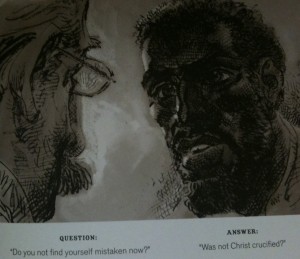
I am sure I am far from the only one who is unsettled by the idea of Nat Turner as a hero (Baker calls Turner “my hero” in his introduction (Baker 7), somewhat coloring the text for me) as well as the central figure of an “indiscriminate massacre,” but I am also rather unsettled by Greenburg’s rather keen observation that Turner garnered his violent plan from the pages of the Bible. Baker directly confronts this issue, depicting Gray asking Turner, “Do you not find yourself mistaken now?”, to which Turner replies, “Was not Christ crucified?” (189). Turner believes that his actions are ordained by God, that his “style of warfare” taken from the Bible is just and righteous, and that his hanging will cement his place as a religious prophet and figure, paralleling himself and his actions to Christ’s own.

In many ways I can understand how the horrors of slavery could drive an enslaved person to violence. What I am having a problem with is the fact that not only is Turner presented as a Christ figure by Baker (a reflection of Turner’s own presentation of himself as a Christ figure, though Gray’s misrepresentation of Turner should also enter this debate), but that in order to accept this portrayal, one must also accept Greenburg’s idea that Turner learned his style of violence — an indiscriminate massacre that targets every white person, not only slaver owners — from the Bible, and that this kind of violence has any place, be it in the pages of scripture or in a southern Virginia town near the North Carolina border as a result of “man’s inhumanity to man.” It is here that I have a difficult time accepting Turner as a “hero” or as a Christ figure for I can’t understand any way, not even through paralleling Turner and his actions alongside those of violent episodes depicted in scripture, that Turner’s actions reflect a true hero or Christ figure, not at least as I have come to understand those terms in today’s world.

As a flawed man, I can understand Nat Turner and his actions; as a hero, as Baker claims early on in his text to conceive Turner as, I cannot — I don’t feel Turner’s actions, even if they are understandable, are in any way heroic.

Text, Images, and History in “Nat Turner”

Moving back and forth between the photographs in the UVa archive and the Baker’s illustrations in Nat Turner, I was struck by the similarity between them.  Barker’s drawings evoke the same tone of old photos: his choice of shading and use of shadows mimic, at times, the feeling one gets looking at tintypes.  His selection of “color” – varying shades of off-brown for backgrounds and darker shades of black – in many ways replicate the lithographs, daguerreotypes and engravings of the period.  His use of photographs as page “headers” (129, 130, 133, etc.) and the insertion of a sketch/photo of an axe (152), complete with manufacturing details and trademarks, also give the novel a sense of the straight-forward history and a chronology of events.

It is highly likely that Barker came across pictures of slaves during his research for the book and was influenced visually by what he discovered.  As he states in the introduction, the genesis of the novel comes from his engagement with history texts and his curiosity about Turner’s rebellion and he is true to “history” in his drawings.

What little written text Barker does use works against the graphic text. The excerpts from The Confessions of Nat Turner move back and forth between a matter-of-fact recitation of events and the wonderfully structured sentences describing his spiritual development and final epiphany. The bland and gentle matter-of-factness of the written text clashes head-on with the brutality of the images. Turner mentions the kindness of some of his victims in his confession and then Baker renders an image of absolute brutality and terror as they are destroyed.

In terms of the mating of text and images, Barker’s Nat Turner is far removed from Spiegelman’s attempt to accurately the story of Maus. The “confession” of Nat Turn could be a distortion of what really passed between Turner and Thomas Gray, and Gray’s editorializing certainly calls into question the reliability of the narrator. Barker’s drawings, however, take much of what is said as a departure point from which he feels free to write a “novel” that captures what is not said, but what is implied by Turner.  The retrospective vantage point of history bears out Turner’s words.

The first panel of the book is nothing more than a pair of eyes and the image of a book surrounded by black.  It captures one of the themes highlighted by Turner in his confession; how the power of the written word can set us free.  Barker mentions the power of written text extensively in his preface and then proceeds to create a text with only a minimum of words.

Nat Turner’s Ambiguous Conclusion

In the end, I was impressed by Baker’s Nat Turner because it left me feeling so conflicted – almost disturbingly conflicted.  As I got toward the end, I was growing uncomfortable with how the rebellion was portrayed.  I thought the ironic juxtaposition of brutal imagery with Turner’s own dispassionate, matter-of-fact descriptions was great, but the Christ-like depiction of his hanging (complete with celestial light beaming down from the heavens) was overly congratulatory.  There’s no doubt that Turner was a great man who stood up against the worst sort of human oppression.  However, he did so by equally inhuman means (slaughtering women, children etc).  You could definitely make an argument that those are the only means that could truly wake people up to the evils of slavery, but I thought the super-martyrdomy imagery and the caricature-like drawing of the bloodthirsty mob was making our minds up for us and oversimplifying the insane (and extremely interesting) moral complexity inherent in Turner’s account.

That being said, I thought the last few panels brought a lot of that ambiguity back to the party.  I inferred that the girl who steals away to read Nat Turner’s confession is Harriet Tubman, especially considering how the timing fits and how Baker mentions in his introduction that the rebellion inspired her, among others.   Considering how, historically, Tubman was illiterate, this may be a stretch.  If this is a valid reading, though, it suggests the possibility that more violence isn’t the only way to resist violent oppression.  As we see throughout the story, it’s education that gives Nat Turner his power to organize and inspire his rebellion.  In Tubman’s case, however, stories (including biblical stories and stories like that of Turner’s rebellion) spur her to take a different approach.  You could see it as Nat Turner’s sacrifice paving the way for gradual resistance and improvement, or you could see it as Tubman learning from the episode, consciously rejecting Turner’s methods, and taking another path.  Or maybe it isn’t Tubman.  Maybe it’s meant to be generic, and the emphasis is simply on the potential of stories and education to give us power to shape our worlds.  Maybe it’s a mix.  In any case, it’s an intriguing conclusion to a visceral, ambiguous story.

Nat Turner: Panel Pics and Color Choices

When I heard that Nat Turner wouldn’t have any text, or, rather, would have very limited text, part of me was worried. I must still admit that it was only a small part of me that worried, because I learned from Dark Knight alone that graphic novel pictures can pack a heck of a punch. I found myself thinking how quick of a read Nat Turner would be, but that wasn’t the case. I spent minutes on every panel dissecting it, trying to distinguish the background shading from the skin, the action indicators from the weapons, and sometimes, it took me a while simply to register what I was looking at. There was so much that was grotesque, disturbing, and/or weighted, that at times I didn’t know where to look or what I was supposed to be seeing until I looked again…and again. (For example page 198 top panel. I can see clearly now that it is a headless body on a table and that the actual head is being held by the man on the right, but when I first quickly looked at it, I couldn’t tell for seconds what any of it was.)

I definitely was forced often to slow down and “read” the pictures. I had to stop and stare to digest what was going on before I could move to the next page or the next detail. And then, what I did see, I am haunted by. How naïve was I to find Maus disturbing? (Half joking here…) Maus still has its moments, but there is much more gruesomeness being enacted for you on the pages here that the violence is shown in the forefront, even when we only see bubbles of the aftermath.

The preface of Nat Turner is very appropriately written, as I was glad to have read it once I finished the novel. Baker calls his story the “perfect subject for a comic book,” and I think, to some extent that that is true (6). The sentence long explanations that the history books give on Nat Turner do not drive home what happened. The history we are taught lets us glaze over the gritty details, but also don’t let us forget that something of significance did happen at the same time. By using such a visual medium to show this story, it is harder for the reader to leave with the same understanding of the Nat Turner rebellion. Even when it is hard to understand what you are seeing in the panels, you are still left with a sentiment for what it going on within them.

This is a story that reminded me of a class discussion. I couldn’t handle these same panels in color. It’s a lot to take in with just the shades of brown, black, and gray. If in these muted tones it still overrides the senses, I can’t imagine what it would be like all in color. In fact, I think it would have made it too “cartoony” even if the cartoon would be completely disturbing. As it stands, it almost shows as an old time photo in its sepia tones. To be in color like it is on the cover would lend itself to a strictly over the top horror genre that I think would be too distracting. Shading and blending make this book have depth; line confusion and make the pictures have more weight. To add color would be to get rid of the confusion for where lines stop and would make the picture clearer, which I think would come to the detriment of art itself.

~Kelley

No timeline

Like many of the other responses to Maus II I too enjoyed the greater interaction between the past and present in this volume.  We see more of the details we needed in Volume I of how the past has shaped the present of who Vladek is and why his relationships are the way they are, but I think more importantly this volume attempts to create a connection between the past and present that is larger than Speigelman’s story.  The simple fact that Spiegelman feels a need to write the story of his father’s survival shows how he sees how this story needs to be told to the contemporary audience, but in this volume we see Art’s struggle to understand that reasoning which I appreciated and made me better appreciate the story.  We see Art’s struggle on page 68 when Art needs to put Vladek’s time in Auschwitz into an understandable timeline, closed and contained.  Vladek responds to Art’s questioning of time saying, “So? Take less time to the black work. In Auschwitz we didn’t wear watches” (Spiegelman 68).  We see the timeline of the right side of the page stretching almost half the page. Spiegelman begins the timeline with Vladek’s entering into Auschwitz in 1944, which seems to negate Vladek’s the struggling and survival prior to Auschwitz presented in Volume I.  However, the timeline Franciose’s exclamation from the present cuts off the timeline, leaving the timeline unfinished and seeming continued into the future.  In Chute’s essay she presents page 68 as a layering of the past and present, but I see it as more a continuation of the past into the present, a history that cannot be contained by a beginning or an end.  I think this need to contain the history of the Holocaust shows a need to keep the past in the past, but we see throughout the novel how that is not a reality.

We see this struggle with the past and its confinement/simultaneous presence through Art’s feelings of guilt and inadequacy in this volume’s beginning.  Art’s therapist pushes Art to question the need for his book and tells him, “People haven’t changed…Maybe they need a newer, bigger Holocaust” (Spiegelman 45).  The therapist states that there is no end to the timeline, people have been the same since before the Holocaust until now – genocide and prejudice still exist.  We see this presence through Vladek’s own racism towards the hitchhiker.  But I think more importantly the therapist questioning of the need for another Holocaust story to push Art shows how history needs to be conformed for the present.  It isn’t that history is confined to a timeline, but that how that time in history is presented gives it an end.  By breaking the mold of creating a nonfiction, biographical comic about the Holocaust he puts an end to the timeline – the past enters into a present medium of history and thus crosses that gap that we see him struggle with in order to understand and present the story.

Forgetting Maus

I recently had a female student from Germany who had gone through the German pubic school system where it is required that students be taught about the Holocaust.  She had read volumes I and II of Maus in the 10th and 11th grades and was clearly exasperated by the experience.  Like the reporter wearing the cat/Nazi mask at the beginning of chapter 2 “Auschwitz (time flies)”, she asked why she should feel guilty for something that happened before she was born and expressed dismay at her country’s inability to move beyond the past, or at least allow her generation to move beyond it.

Should time and our removal from events mitigate the horrible things done by “us”?  My student regretted the Holocaust and “felt bad” about it, but didn’t feel a part of it.  Children of Holocaust survivors, like children of American Indians or children of slaves, do remember; as Chute discusses in her references to postmemory, remembering is the burden survivors of collective trauma must carry.  The difference, it seems, depends on which side of the prison fence we view the situation from.

Artie is on the inside looking out.  He didn’t perpetrate the horrors of the Holocaust, nor was he a victim in the camps, but unlike my student, he doesn’t have the luxury of forgetting. Writing in 1978, with Holocaust victims piled at his feet and a prison camp guard tower outside his window, Artie is as much of a victim and prisoner as his father, only his prison is his guilt.(41) Pavel tells him that, although he is in Rego Park and not Auschwitz, he is the real survivor. (44)

On pages 42 – 46, Spiegelman draws himself as a child, implying that he is unable, like Vladek, to extricate himself from his prison.  Artie is compelled by his father’s story; he is as trapped in it as his father was in Auschwitz and Dachau. Vladek’s survival mode is to be as useful as possible to his captors; to be an English teacher, a tin smith, a cobbler.  Most of all he credits he strength and good health for his ability to survive the beatings and anguish inflected on him by his captors.  Artie’s survival mode is to be as useful as possible to his father while surviving  the slights being heaped upon him.  When Francoise suggests staying in “Mauschwitz” a little longer to help Vladek, Artie says he doesn’t think they’d survive.

Artie’s survival mode is also to create “Maus” and to not let the Holocaust become part of the past. Those who wish unpleasant facts to go away, as my student did, need to understand that they are now part of a collective worldview, which is why Maus is required reading in German school systems. As Chute mentions, the trauma Maus represents is unending; there is no closure or finality. Maus is a tale that adds the future to the past and present as Speigleman suggests in his proposed title for a Holocaust Museum exhibit: Never Again and Again and Again.

The Artist’s Signature

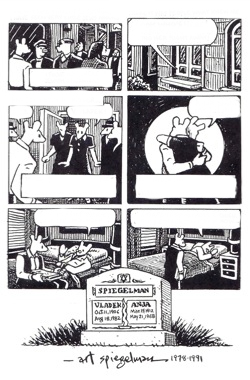
Inspired by Ian’s post on Chute’s essay, which put a lot of my jumbled feelings about “The Shadow of a Past Time” into words, I’ve decided to take issue with Chute’s reading of the final panel of Maus II: And Here My Troubles Began.

While much of Chute’s essay demonstrates her grasp of the text and the ideas she posits are within Maus, many of her points — most of which can be boiled down to a sentence or two, as Ian does succinctly in his post — are so exhaustively argued that the essay leaves very little breathing room or space for other avenues of thought. While focused on the final panel of Maus, “the penultimate punctuation” of the text, Chute seems completed alluded by one of the simplest, yet most profound observations: Art Spiegelman’s signature is just that, an artist’s signature, a demonstration of Spiegelman’s ownership and responsibility for Maus, something he struggles with earlier on in the second volume.

Others have strongly pointed out the more meta-fictional properties of the second volume of Maus. Indeed, entire sections of the graphic novel are composed of Art Spiegelman’s doubts and concerns about the project he has undertaken, playing not only with Spiegelman’s mice/mask metaphor, but with the full visual potential of a graphic novel — here I am thinking of the pictorial depiction of Spiegelman being reduced to a crying child, not only emotionally, but physically within the confines of the text. While Maus is in many ways Vladek Spiegelman’s life story, the narrative of Maus is actually of the artist creating Maus: interviewing (and, as we see numerous times within the text, pushing his father to recount, perhaps traumatically relive, the horrors he survived) the subject of the story, creating animal masks for his the characters that populate Spiegelman’s rendering of not only his father’s story of survival, but his own story of an artist in the process of creation, and so on.

While I do not necessarily think Chute is completely off the ball with some of her thoughts on the final panel, the idea that she could not see, as I did, an artist saying, “Maus is the story of my father’s survival, but it is my version of his story/history,” perplexed me, especially given how often Spiegelman seems to question his ability and choice to take on a project such as Maus. I felt this panel was not only a tribute to his parents, but a clear cut sign that what we have just read is a story by Art Spiegelman, artist and writer, narrative and pictorial shaper of another person’s story which is paralleled alongside his own subjective account of being an artist in the process of creation, of being a flawed son to a difficult father, of being a husband and father himself, and so on.

Is Spiegelman “buried” by his parents’ history? In many ways, yes, but I do not feel that this is the reason the signature rests in the white, empty space below his parents’ grave — perhaps I would feel differently if the graphic space seemed filled, not only with soil and caskets, but with history, or if I could honestly believe, as Chute appears to, that the panels on the page actually travel “upwards” — when my eyes fell on the gravestone, they stopped. Also, artists’ signatures are typically at the bottom of their work; while I do think that there are points to be made about the signature’s placement and proximity to the grave stone, I don’t think these points should be made at the expense of the obvious.

Are some of the other points Chute makes about the final panel worthwhile, even if only as the beginnings of worthwhile conversations? Again, yes. It would just be easier to take many of her readings in stride had she not missed one of the most obvious and important aspects of an artist’s signature, especially at the end of a text about an artist’s father’s story of survival, a project the artist has struggled with and been humbled by. I think the conversations that could be prompted by the idea of Spiegelman taking responsibility and ownership for Maus are far more interesting than the ones allowed by Chute’s analysis of that final panel.

[Again, riffing off Ian, I was pretty close to titling this post “Chutes Too Narrow.” Yeah, I know. I’m a dork.]

words, words, words…

Looking through the final chapter of Maus, I’m struck afresh by how many of the images shown are headshots. I’ve been teaching a bit of visual rhetoric in my English 101 class this past week and we’ve talked there about how these type of perspectives in media emphasize emotions of intimacy, directness, honest conversation…

It’s completely understandable why Spiegelman relies so heavily on this particular angle in the last chapter, and throughout the book. As we read in Brown and discussed at length in our class last week, Maus is primarily an exploration in oral history, in memory and imposed meaning. Of course conversation is going to be emphasized!

But it also strikes me that Maus may rely on the printed word a bit more than the previous graphic novels we’ve read. For example, I think you could probably read The Dark Knight Returns and figure out an awful lot of what was going on—“subtexts” and all—from the visual narrative alone.

I’m not sure, as of yet, if you could do that with the visuals of Maus. Rather than a sin of illustration omission, however, I suspect that this has to do with the fact that this piece may contain far more subtexts, far more intricacies than any of the other texts we’ve perused so far. For example, how much can you glimpse, let alone unpack, all the intricacies of the last page of Maus (as discussed by our Chute reading of the week) from visuals alone?

Maybe it’s unfair to compare Maus to Miller. And yes, Watchmen and Sandman both had visual narratives that were also purposefully set off against the written narrative. But I can’t help thinking that the written narrative of Maus is quite a bit more complicated and integral than any other text we’ve examined yet.

Maybe it’s the inherent nature of “nonfiction.”

Again, if nothing else, emotions are simply depicted in Spiegelman’s drawings, forcing our in-depth deciphering process to rest chiefly on the written word. Which we have to do; at both a basic and more complicated level, this is a book about relationships, past and present, as that final page of Maus clearly comments on.

Have you tried looking at these books without reading the words? Imagining a page with nothing but pictures (a lá Eric Drooker’s Flood)? What revelations—if any—has that given you?

As a final, somewhat-related note: I had a hard time with Chute’s point making Spiegelman into an overt modern-day political commentator via bodies in the trees near the road, etc…you?