
“I Made This You Play This” = Work of Art

As I played through each game assigned for next week, I found myself the most interested in “I made this you play this. We are enemies.”  At first glance, the game seemed like a complete joke; totally sloppy, loud and obnoxious, complete definition of nonsense.  I tried reading everything on the page in an attempt to make sense of the abomination happening on my computer screen.  Yet, as I kept playing, the game began to develop a theme.  Each level’s design is based around a website or franchise.  When I got to level 3, I began to understand that Nelson was attempting to send a message to the gamer.

I view Jason Nelson’s creation as a work of art first, and a video game second. Like most works of contemporary concept art, I would assume that the average person would spend roughly one minute playing through “I made this you play this” before getting a headache and moving on to another website.  However, those who brave the next few levels should notice the real concept of this game.  I believe Nelson has created an abstract contemporary work of art, not unlike works by Jackson Pollack and Marcel Duchamp.

Galloway states in his text that countergaming has few game rules and replaces play with aesthetics.   Though this game’s aesthetics are not particularly attractive, I support the assumption that Nelson has “dumbed the design down” purposely to further support his views of franchises and society’s materialistic nature.

 

Posted in First Readers | 2 Comments

Evidence of Everything Exploding

I found Galloway’s article extremely interesting. I did not know that the genre of mod games was out there. I find it extremely interesting that people take aspects or codes of games and turn them into something completely different than what is their original form. The game I chose to look closely at is Evidence of Everything Exploding. At the beginning of the game it tells the reader it’s all about conspiracy theories because that is what Hollywood is obsessed with. When I started playing the games for this week I noticed that aesthetically they don’t resemble the typical game. According to Galloway, “countergaming often has no interactive narrative at all and little gameplay supported by few game rules, if any. In this sense, countergaming replaces play with aesthetics.” This was clearly evident in Evidence of Everything Exploding because they game was simple, because all I had to do was to open boxes and make it to the end in order to move on to the next level. The game also had visual artifacts, which are “undesired cosmetic disturbances such as jagged edges or dirty patches in an image file.” The game had multiple red lines that would pop up randomly and get in the way of my view. There was also excess noise and noises when I would hit an object. Although the game is a countergame, it does have some characteristics of a conventional game, such as having different levels and some of the same movements, such as jumping. I’m not exactly sure as to what the cultural or political message to this game was but it was definitely not like any game I’ve ever played and showed me a completely different genre of videogames.


Posted in First Readers | Comments Off on Evidence of Everything Exploding

Game, game, game, and again game

I played Game, Game, Game, and again Game and I thought about Galloway’s chapter about “countergaming”, and I started thinking about how the the six differences he listed apply to this game. Some of the things Galloway listed were very relevant and were obvious differences in this game compared to mainstream games I have played in the past.

The first think I noticed was the background of this game. Like Galloway lists as Aestheticism, this game did not focus on rules very much. At the beginning, we are given very simple instructions on how to move through the levels, but that’s it. And you do not have to do much to pass a level. Basically you just roll through to get to the door and it requires very little thought. Much more emphasis is put on the images seen in the levels. Each level has unique pictures and a link to open a home video, or “video proof” as he called it. Every level is just a flash of moving words, creatures, and random pictures somehow linked to the name of the level. For example, “The Faithful” level has a cross. On the opening page, Nelson even wrote the words “design, design, design”.

I also noticed how there was some “invented physics” in this game. For example, on one of the levels, you have to roll up a hill. If you stop halfway, you do not roll down like realistic physics would predict. You instead just sit there in that spot.

There were some visual artifacts also, where you get sent back to the beginning if you hit the creature that it is “not alive” as an example. Also when the screen jumps to a random picture or word when you hit a certain spot. This breaks the illusion of representational modeling that conventional games have.

There was one thing that I noticed was not common of countergames and that was interactivity vs. noncorrespondence. In this game, I could see a player-game relationship where I was in control and could see my movements instantly, which Galloway said is more common with conventional games versus countergames.

This game and the others we were supposed to play were the first “countergames” I have ever played. From what I noticed, the biggest difference was the lack of reality in many of them. It is not about the best, most realistic visuals. These games instead use words, videos, made up creatures, and anything else they can think of to make their statement.

I had trouble trying to figure out what the underlying social statement was though. The flashing of words and pictures was hard to follow and gave me an instant headache. Can anyone help me out here?

Posted in First Readers | 1 Comment

Countergaming without Modding

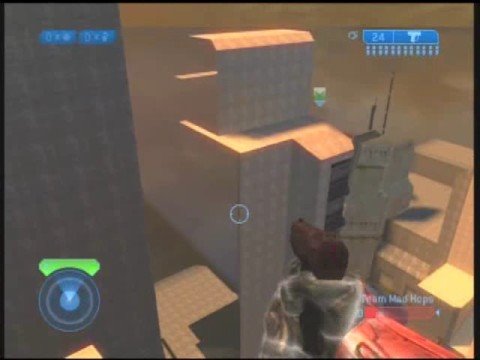
This latest chapter from Galloway described countergaming and its prevalence in mods throughout the span of blockbuster game titles.  I would like to challenge the restriction of countergaming to just mods and offer the possibility of a form of countergaming being within certain mainstream games.  Now I do not mean that the user takes actions to simulate countergaming, I meant hat the user, by exploiting certain glitches and/or bugs in the game, transforms the space into a form of countergaming and an abstract expression to be explored.  My example is from 2004 the highly anticipated game, Halo 2.  At first glance this game just appears to be a normal shooter genre game that was very successful.  In my experience with the game as well as a sizeable part of the fanbase, there were many glitches that could be exploited to amusing effects such as the “super jump” shown here: Halo 2 Super Jump.  Using this and a variety of techniques, a player could work their way “outside of a level.”  This space being defined as going outside of the designed space by developers.  This led to interesting consequences.  When outside of the level, the game stopped acting as a game.  This is where it transformed into a counter game instead of a game.  Transparency was lost.  Instead of being in a continuous virtual world, you could plainly see how different parts of the game were constructed and used to create the illusion of a unified space.  Both gameplay and aestheticism were lost.  Controls often did not function as usual due to invisible walls, disappearing platforms and other events that cannot be explained.  The space was covered with artifacts, buildings and scenery all turned into 2 dimensional flats with no little to no detailing and gaping holes in them.  In this chaotic space, the machine was in almost complete control.  players could die or be shot out of the world in an instant.  This space contains many of the main descriptors of countergaming and thus I see no reason to not consider it a form of countergaming.  The only missing element, although substantial, is purpose.  This however is not essential to be considered countergaming.  In the following image the player is looking outside of a level shown by the gap in the building.  Once in that space, the countergaming begins.

Looking outside a level

.


Posted in First Readers | 3 Comments

Virtual Reality Combat Simulations as a Treatment for PTSD

http://www.veteranstoday.com/2010/05/18/dr-sally-satel-promotes-virtual-reality-war-games-as-a-treatment-for-ptsd/

We mentioned in class the use of video games and virtual reality to help war veterans with post traumatic stress disorder (PTSD).  I found this article online about it.  Make sure to read some of the blog comments, I found some of those to be more interesting than the actual article.   I did read that the high amount of blog comments created a lot of buzz about the topic in general online.

Posted in First Readers | Comments Off on Virtual Reality Combat Simulations as a Treatment for PTSD

More details for the “Countergaming” Reading

We can think of countergames as anti-games, or games that are everything that games aren’t supposed to be.

In his essay on “Countergaming,” Alexander Galloway outlines six differences between conventional videogames and countergames:

  1. Transparency versus foregrounding
  2. Gameplay versus aestheticism
  3. Representational modeling versus visual artifacts
  4. Natural physics versus invented physics
  5. Interactivity versus noncorrespondence
  6. Gamic action versus radical action

Galloway describes his formulations, which are inspired by the oppositions between traditional Hollywood cinema and the experimental filmmakers of the sixties, more fully in his essay. We are going to be using Galloway’s “grammar” of differences to analyze one of the anti-games developed by Jason Nelson, an American new media artist.

  1. First, read Galloway’s chapter.
  2. Next, play/explore each of these four online games by Jason Nelson: (1) I Made This. You Play This. We Are Enemies, (2) Game, Game, Game, and Again Game, (3) This Is How You Will Die, and (4) Evidence of Everything Exploding. Note that you’ll need Flash and Shockwave installed in your web browser, and you’ll also need to enable “pop-up” windows. Be sure to use speakers or headphones, because the audio is central to these games.
  3. Pick one of the games to look at more closely. Think about how it evokes some or all of the six characteristics of countergames. Does the game privilege any characteristics of conventional games as well?
  4. Are there ways beyond Galloway’s six categories in which Nelson’s work is a countergame? That is, has Galloway accounted for every conceivable difference between a conventional game and a countergame like one of Nelson’s?
  5. Finally, think about to what end has Nelson employed countergaming methods in the game you’re studying? What sort of cultural or political statement is Nelson making in the anti-game?
Posted in Announcements | Tagged , | Comments Off on More details for the “Countergaming” Reading

Atari for the iPhone/iPad!

A friend of mine posted this link on Facebook tonight, and I was really excited to see it. The emulator is a free download and comes with Pong, and you can download additional games for 99 cents. Awesome!

http://www.macrumors.com/2011/04/07/ataris-greatest-hits-for-iphone-ipad-and-icade/

Posted in Uncategorized | Comments Off on Atari for the iPhone/iPad!

What video games are your kids playing?

This interesting article by PBS discusses how most parents have no idea what video games their kids are playing. It addresses Dylan Klebold and Eric Harris, the boys at the center of the Columbine Massacre, and the games they played prior to the shootings. It also includes interesting statistics and facts about video game ratings.

Posted in Uncategorized | 1 Comment

Hurricane Katrina: Tempest in Crescent City

I found this game based on the Hurricane Katrina disaster. Note: it doesn’t work in Safari, so try Firefox if it isn’t working in Internet Explorer, either.

In the game, you take on the role of a young girl traveling to find her mother. The game opens with the girl in New York City, remembering the events of the hurricane and “wishing she could have helped her.” Along the way to finding her mother, she must help her neighbors by bringing them items and breaking them out of their homes. As the levels progress, the water level is increasingly higher and the time in each level is limited by the amount of natural light available. In addition to shedding light on the reality of the hurricane, the game criticizes the government’s initial involvement in relief efforts. A character standing on his roof comments that “Cuba wanted to send 200 doctors [to help] but the State Department said no.”

The game’s tribal soundtrack and comic-book graphics contribute to the game’s “adventure” tone. The game is not meant to evoke sympathy by exposing devastation and personal tragedy, but to motivate action for change and protest.

Posted in Links | Comments Off on Hurricane Katrina: Tempest in Crescent City

The Empirical Literature

The article by Simon Penny was just one side of the debate about video game violence that has been taking place in academic journals. Wikipedia has a short overview of the subject. That is only the tip of the iceberg on the subject, a Google scholar search of “violent video games” produces 5,130 results.

The part of the wikipedia article that sums it all up best is a quote from Henry Jenkins:

“According to federal crime statistics, the rate of juvenile violent crime in the United States is at a 30-year low. Researchers find that people serving time for violent crimes typically consume less media before committing their crimes than the average person in the general population. It’s true that young offenders who have committed school shootings in America have also been game players. But young people in general are more likely to be gamers — 90 percent of boys and 40 percent of girls play. The overwhelming majority of kids who play do NOT commit antisocial acts. According to a 2001 U.S. Surgeon General’s report, the strongest risk factors for school shootings centered on mental stability and the quality of home life, not media exposure. The moral panic over violent video games is doubly harmful. It has led adult authorities to be more suspicious and hostile to many kids who already feel cut off from the system. It also misdirects energy away from eliminating the actual causes of youth violence and allows problems to continue to fester.”

Posted in Links | Comments Off on The Empirical Literature

Controversial games…

So, I wanted to give you this list of games that I found as the “Top 12 Most Controversial“. This list has some very interesting/disturbing games. I can’t even pick one that is most disturbing because they are all disturbing for their different reasons. Most of these games (Rapelay, Ethnic Cleansing, etc.) should not have even been made. I am a fan of artistic freedom but I also think that the game designers should limit themselves to not create games that encourage the direct harm of the innocent. RapeLay (which I think we’ve talked about in class) puts gamers in the mind of a rapist. This has the possibility of encouraging a gamer to “find” the rapist inside himself and that gamer (if unbalanced) may take it to the next level and act it out on someone else. I know that putting regulations on game content could be considered as taking away personal artistic freedoms, but what do you think? Would it be for the greater good if games like these weren’t allowed to be released?

Posted in Links | 8 Comments

Video of 9/11 Simulation Game

We discussed and either viewed or played two controversial reenactment video games in class today. I have found a video of a simulation game for the 9/11 attacks which would fit under the title ‘controversial’ as well. It is indeed a little disturbing watching these reenactments of actual events. The idea behind this particular game is similar for the “Virtual Iraq Video Game” (found in the post below). It would be used to help post-traumatic stress disorder (PTSD) victims/witnesses cope with life after the incident.

Click here for the 9/11 simulation game video. Some additional information I wish to share which intrigued me was that the author for the 9/11 simulation game uses the Doom3 engine. I find this particularly interesting because the article for today focuses on possible behavior relations linked to playing video games and mentions Doom, and in the “Super Columbine Massacre RPG!” game Doom was mentioned by one of the perpetrators. It went something like this (paraphrased) “going to be fun (killing), just like in Doom!” Just a coincidence no doubt. Although, I have never played Doom. Could a classmate of mine who has please watch the simulation video and tell me if the screams at the end are in Doom? I find it interesting that Doom is linked, in different ways, to all three of these games.

Posted in Links | 2 Comments

Iraq Veterans, PTSD, and Video Games

I dug up an article that Professor Sample referred to in class today about Iraq veterans playing video games to help overcome PTSD.

Games Help Treat Military Veterans For PTSD

Interestingly, an article posted more recently suggests that veterans should avoid war games because they trigger too many memories of their war experiences.

Veterans Warn Soldiers With PTSD to Avoid War Games
 

I’m guessing the biggest difference is in the games themselves–the first is an innovative game specifically designed to help veterans, while the second article refers to games like Call of Duty.

Posted in Links | Comments Off on Iraq Veterans, PTSD, and Video Games

Playing “Like a Girl”

http://kotaku.com/#!5598679/what-i-discovered-from-gaming-like-a-girl

We discussed in class how different types of people think in different ways, and thus are attracted to different sorts of video games.  Two of the most obvious groups of people who think differently are men and women.  In her article, Leigh Alexander explains how the option to play as a female character in Persona 3 for PSP changed her view of the game.  Her play through as a female character differed from her experience through the eyes of a male avatar, causing her to reflect on the values that real world culture had enforced on her as a woman.

She notes how when she played as a male, the game encouraged “playing the field,” as Persona’s mechanics reward making social links with various people.  However, while playing a female character, her romantic choices were more limited.  While Alexander questions if this is a statement about how it is considered un-womanly to act in such a way, I see a different message in light of what she has said about the rest of her gameplay experience.  Persona is suggesting that the way for a male to manipulate people, thus receive the highest statistical rewards, is to be a player.  Additionally, this can be done because is somewhat acceptable by societal standards.  This behavior is not acceptable in the eyes of most people when performed by a female.  However, females have a more subversive and subtle form of duplicity inherent in attempting to be likable and fit in with societal norms.  Thus, the female side of Persona 3 for PSP provides more of these friendship relationships.

Though it is ironic that the “dating sim” element of the game is more prominent when playing as a male.  Still, whether or not it is more ironic that “winning” at Persona can not be quantified by simply having the highest stats, I can not say.

Posted in Links | 2 Comments

Simulation- Fact or Fiction

The point in essence, of both the articles was that video games are powerful teaching tools.  In the first article the authors made the argument that video games train the people to kill people.  While people might gain skills, such as shooting or hand eye coordination from playing these games i don’t think that there is a proven causal relationship between playing video games and going out and shooting people.

I as a player of these games i don’t feel any desire to kill other people.  The games might teach some skills that aid in the killing of other people but they certainly don’t prepare people to kill other people mentally and barely physically.

The other article is on the moral implication of simulating historical events in games.  I think the controversy comes from the fact that people really don’t talk about non controversial events that are simulated.  Columbine and the JFK assassination are things that people consider bad things and playing as the person who commits these events is very controversial.  The same argument is implicit in these arguments that playing games are more likely to commit these these actions.  People don’t like to think these things because they already have a narrative of these events and playing them out can change how they are perceived.

Posted in First Readers | Comments Off on Simulation- Fact or Fiction