
Yesterday’s class was a lot of fun for me talking about being a Nintendo kid and such and especially when Pokemon was brought up. I played Pokemon blue like it was no ones business. I found this clip and thought it tied well with games having a narrative but this is the flip side. Even though its a spoof, it made me laugh thinking about how they could bring such a classic game to life and give it a story like most films out there. Hope you guys find it funny (and sad, I’m not going to spoil it) like I did!
Copyright
The reading this week brought up the idea of copyright: more specifically, that that King Kong and Donkey Kong could be distinguished from one another and be made to generate their own profit. At its conception, ‘King Kong’ was one of the most successful films to date, earning it both the standard fame of profit and the conceptual fame of idealized morals and stories.
With the idea of “Beauty killed the beast” (as proclaimed by the popular film), the idea of the design of a gorilla as a superhero was not a farfetched one, as suggested by the popularized proposal that he was completely foolish and pigheaded.
The game was proclaimed to “suggest a renegade primate, like King Kong, who was renegade and primate, like a donkey” (115). However, if that were the case, I feel that the commercial appeal of Donkey Kong who be hard to come by. Rather than believe that the idea that donkeys are heard-headed and absolute, I feel that the idea of “donkeys” has been glorified by the idea not only of different perception but also as for each person being ambushed because he might not agree with a certain logic. However, even though someone may or may not enjoy a certain game does not mean that he can’t enjoy another: eventually what it comes down to is each person’s personal perception and his willingness to adapt to change and logic. Even though I might feel sympathy for King Kong does not mean I can’t feel sympathy while playing Donkey Kong the game.
Posted in First Readers, Uncategorized
Comments Off on Copyright
The Goal of the Console
Nintendo cornered the video gaming market in 1985, relying on the collapse of the American industry to allow them to gain control of 80% of the market, all the while maintaining quality control over any software published for their system. Their monopoly garnered much of the attention of the software market which allowed them to produce a large amount of quality games for their console, without having to produce all of these games themselves. It also allowed Nintendo to work on a small amount of extremely high quality games for which they have become well known, such as Zelda, Mario, and Donky Kong. If anyone has played Mario and Donky Kong, both games have extremely similar play styles, similar objectives, and are roughly the same games with different skins. In fact, the original Donky Kong games did not even involve playing the Ape and the player assumed the role of Mario attempting to rescue the princess from the ape Donky Kong. Kong later receives a promotion to full fledged hero later in the series, with gameplay almost identical to the Mario formula.
Posted in First Readers
Comments Off on The Goal of the Console
Response to ‘Nintendo and Marketing’
When I think of my childhood, certain things stand out in my mind: the Easy Bake oven, Legends of the Hidden Temple, and Playdough. However, my predominant memory is that of the Nintendo. Beginning with the original console, my family owns every model that was released up until the Wii. Despite our consumer electronics conformity, though, I would not define myself as a “Nintendo kid”. I was more of an adopted Nintendo kid, or a twice-removed, grafted-in Nintendo kid. Since the majority of my childhood occurred in the late ‘90s and early 2000s, I was slightly beyond the Nintendo boom that rocked my older siblings’ worlds. This is why I define myself as adopted: Nintendo was a hand-me-down of sorts from my older brother and sister.
To elaborate, I never asked my parents to buy me a specific NES game until we got the Nintendo 64. This was the first console that was given to me, instead of to my brother or sister. Before this, the various consoles were simply there—as in, they were in the basement or in my siblings’ rooms. Since I wanted to be cool and hang out with them, I had them teach me how to play. Thus, I began playing games like DuckHunt and Super Mario only after my sister or brother got them for their own amusement.
So, I am going to amend Rebecca’s original post by asking this: do you think of yourself as an original Nintendo kid, or an adopted Nintendo kid, like me? Other familial denominations are welcomed, if you care to explain your reasoning.
Also, to answer the rest of this post, I rarely buy videogames anymore. This is because I have about a sliver of the free time that I had as a child, and because I have a driver’s license (i.e. I do other things for fun now that I’m older). The last game I bought was Guitar Hero II, and the last Nintendo game I bought was Mario Kart for the Wii. I honestly can’t say what I look for in videogame advertisements, because I’ve never been tempted to buy a game based on a television commercial or a magazine article. Instead, I bought games after playing them at a friend’s house, since I wanted to continue the fun at home.
Sidenote—when I saw “‘lock and key’…cartridges”, I immediately remembered how I used to have to blow into the end of the game to remove the dust that was preventing it from loading properly. Can anyone explain why a little bit of dust would mess up a game? Thanks in advance.
Posted in Respondents
2 Comments
Impressed
I personally have zero experience with all things Nintendo. My parents very successfully managed to shelter me from the world of video games. I did not know what an Atari or Nintendo was until high school so everything in Kline’s article, Electric Frontiers, is completely new to me. My first reaction to the article is that I was very impressed by Nintendo’s business and marketing strategy and success. It is quite amazing what they had done. They began exploring the “play value” and had children testing thousands of games a week and completing evaluations based on quality of graphics, sounds, initial feel, play control, concept/story, excitement/thrills, lasting interest and challenge, and overall engagement. These evaluations resulted in great success for the company. They also established phone lines for game counseling where in turn they would gather further consumer data. Investigating “play value” and the use of game counseling helped Nintendo achieve the proper flow to keep their consumers engaged.
I was also impressed by how they took a risk to buy mass quantities of microchips so that they game consoles could be reasonably priced. They overcame Atari’s earlier problem of lack of memory. The microchips allowed them to improve the game quality and livability. Also, to link back to our discussion last class on narrative, the article explained the origins of Mario, which is one of Nintendo’s platform games. Mario is a good example of how narrative can accentuate a game, but it is not necessary. I played Mario Brothers 3 without any knowledge of the story and it was fine and dandy. Now that I know the history of Mario throughout the various games, it doesn’t really change how I play the game, its just cool to know.
Finally, I wanted to take a look at Montfort’s five levels: platform, game code, game form, interface, and reception and operation. I found it very interesting how Nintendo controlled many of these elements of games. They had a monopoly over the platform after they won the law suit against Atari. They had very strict rules about what could be in the game code and how the game could shape itself. It reminds me of Apple’s strict rules for apps in the app store. Nintendo had a lot of control over the gaming industry and I am impressed by the way they influenced all five of Montfort’s levels.
Posted in First Readers
3 Comments
Frustration in Mario Bros 3
So i just spent the last hour playing Mario Brothers 3 and finally was able to get past the first castle. I actually have a headache now because of the frustration I had playing the game. It may be because I’m used to having a controller in my hands but I feel like there was more than just that as to why I couldn’t get past those jumping turtles without dieing.
We keep mentioning in class that a good game is not too challenging but not too easy. I found this game pretty challenging and that’s why I got so frustrated. I found that the character had a very slow response rate. If I was running forward and wanted to turn back around, by the time Mario started heading in the other direction the turtles had already jumped on me. It was also hard to control the character in mid air so he could land on the creatures and kill them. Did anyone else experience these difficulties?
The only reason I would hit my head on the question marks was to see if there was a mushroom or feather underneath it so I could level up. Once I knew where all the mushrooms were I’d only hit that question mark and leave the ones that only gave you points. The points became irrelevant to me the more I played. I don’t know if this was the case for most people. I feel like once someone has mastered the game, then the points would matter to them because they’d keep trying to beat their high score. Other than that, I don’t see the purpose of keeping track of your score.
Posted in First Readers
5 Comments
Nintendo and Marketing
According to Kline, Nintendo created a near monopoly on video games by doing a few things. By creating the “lock and key” in their cartridges, Nintendo was assured that only they could produce games for their systems. By allowing other companies to produce the software (cartridges) that required their approval to sell, they were able to market a larger variety of games available. And by developing the marketing of the Nintendo brand, they were better able to develop a loyal consumer group.
Marketing began by developing research groups that looked into player response to a game, and grew to the point where kids would be testing the new Nintendo games. It was not only these tests that gave an idea as to what types of games would be most popular, especially as they were tested by the target audience, but also Nintendo’s other marketing strategies. The Nintendo magazine, Nintendo Power, gave a good advertising advantage. Having a gaming magazine solely for their brand allowed for marketing new games, it assured that there was no competition from other brands. It separated it’s readers from those who played on other consoles, as the information it contained was only useful for those playing the Nintendo brand. Additionally, the phoneline for help with games helped to create a positive relationship with the brand as it was Nintendo providing the support. Using the marketing techniques, Nintendo created a brand that was not only recognizable, but desirable as well.
After reading about how Nintendo created the “Nintendo Kids”, I have to wonder, how many of you were Nintendo kids? If so, did you evolve with Nintendo and buy the consoles as they were developed? And how do you buy games now? What sort of things do you pay attention to in game advertisements?
Posted in First Readers
2 Comments
Nintendo, Money, and Innovation
Nintendo is a company that makes money. According to Financial Times in 2007 Nintendo made 1.6 million dollars per employee. Nintendo is a company that has not changed much throughout the years. Nintendo figured out a process that works for them, and has keep to it. When they started with video games they wanted to be low cost to increase market share and they have continued to do so. The Wii is the cheapest console of the current generation. When the NES was being developed they wanted motion control and wireless controllers, which they currently have. Rather than letting technology decide how games will be played Nintendo decides how they want to play games and builds the requisite technology.
Nintendo has always been innovative in hardware. Before the NES launched there were prototypes of advanced features. At the Consumer Electronics Show of 1984 it had a music keyboard, light zappers, typing keyboard, a tape recorder and wireless controllers. The NES even had motion sensing capabilities via the Power Glove. In 1995 Nintendo tried to conquer 3d gaming with the virtual boy, one of Nintendo’s failures. Many of these innovations were far ahead of their time. While specialty wireless controllers have existed for several console generations, it was not until the 7th generation systems (Xbox 360, PlayStation 3 and Wii) that wireless controllers became the norm. The 7th generation is also the first to have an emphasis on motion control, from the Wii to the Xbox Kinect. The Nintendo 3DS will launch soon, returning Nintendo to 3d gaming. With the GameCube Nintendo was able to try out other innovations, such as using Gameboy Advances as controls to give players different information.
Lastly I’m not sure how to source my knowledge about the NES at CES, the info is from a sign at Nintendo World in NYC, you can find some pictures of it at http://www.nesworld.com
Posted in First Readers
Comments Off on Nintendo, Money, and Innovation
Videogames and Art
We’ll be talking about the question of videogames as art later in the semester, but for now I wanted to point your way toward a recent overview of 10 artists who use videogames as their medium.
In a similar vein, the Smithsonian is putting together an exhibit, The Art of the Videogames, which will run from March 2012 through September 2012. A year too late for us, alas.
What really interests me is that these two visions of art in videogames that I link to above are totally different from each other.
Posted in Links
Comments Off on Videogames and Art
Minecraft: People have a lot of free time
As should be obvious my post as a seeker is about minecraft. This indie game involves players wandering a blocky countryside shaping it as they see fit to create structures, mine resources, and survive monster attacks. It has been mentioned before by Cole in an earlier post. What I find interesting is the vast numbers of you tube videos and pictures posted on the internet of people’s creations.
I was curious as to the numbers of these videos and people had used the game to create.
There are 680,000 videos on You tube that result from a search for “minecraft” and about 9 million image results for a Google image search.
I think the reason behind this prolific creation of minecraft artifacts is based in the enjoyment people derive from the game. There is not really a point to this game besides creativity. Sure it is fun to survive from monsters and find minerals but those elements are quickly “groked”. What players really enjoy is the creativity of the game. As an artist can derive pleasure from other people enjoying his/her work so the players of minecraft like to display their “art” for others enjoyment. The game is limited only by players creativity. Here are some things people have done.
More “normal” game creations: The Earth, Roller Coaster, Huge Castle
More “unique” ideas: 16 bit ALU computer, Zombie Dance Party
I thought this was interesting because it was basically trying to add a story to the game.
So to wrap up I find it fascinating what people are doing with Minecraft and how they are presenting their ideas online and shaping the game as a result.
If a movie is a story, and a game is a movie, is a game a story?
Many people have argued for or against the idea that games can be stories, but I believe no one would say that a movie is not a story. If you agree that movies are stories, then what about games that consist of equal parts movie as they do gameplay. My example for this is Metal Gear Solid 4: The Guns of the Patriots. This game contains around 9 total hours of cutscenes that are seperated from the rest of the single player campeign that must be played to trigger said cutscenes. The final “movie” at the end of the game lasts a whopping 2 hours, yes two hours of nothing but non-player controlled characters talking to each other about events that caused the conflicts during the game, and culminates with credits. Many people have a hard time sitting through a 2 hour movie, but the idea that the winning moment of MGS4 is guarded by a devil that only time can defeat has caused the game to have many negative reviews from people who have played it, despite having a solid campeing laced between the hours of watching your characters slowly eek out plot points and twists. 9 hours of cutscenes makes me believe that MGS4 is more story than game, showing that games can be stories.
The actual player controlled portions of the game take 44 posts on YouTube to completely show, each lasting between 4 and 10 minutes.
Posted in Respondents
Comments Off on If a movie is a story, and a game is a movie, is a game a story?
Narrative in Video Games
Narrative in Video Games: Just an article that i found on another gaming blog that is discussing exactly what we were talking about in class. There are also some interesting comments as well.
Posted in Links
Comments Off on Narrative in Video Games
Glee
http://www.youtube.com/watch?v=e1_B9FCZJMA
Last semester, when this episode of Glee aired, I thought to myself: What the heck is an Atari? Fortunately, now I know. (“I guess she’s an Xbox, I’m more an Atari”) I thought it would be more entertaining to watch than the Atari commercial Professor Sample posted.
Posted in Uncategorized
1 Comment
Playing for the story or for the experience?
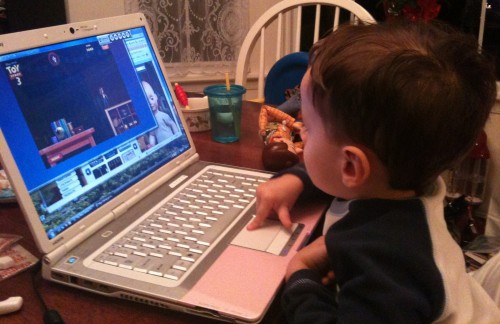
In response to gaming and how the player is emotionally attached to his/her avatar, I have posted this picture of my son in his “gaming mode”. If you haven’t noticed, there is a Woody doll lying on the table as well as running across the computer screen. I agree with this article’s (http://gamesareevil.com/2009/04/narrative-in-video-games/) claim that we play for the emotional experience, thus why we find importance in the skin of a game.
I came across this informational video as i was trying to find examples of video games that have narratives (I found out later this video is one of the many on extra credits; the link another seeker had previously posted). However, the video presents an argument for why narrative/storytelling in games is found more frequently now as opposed to back in the times of the Atari. Not only does Floyd explain the evolution of technology and the complication of including a narrative within the interactive medium a game presents, but he also includes the limitations created from trying to market a game that is heavily narrated. I don’t remember this point of sales pitch to the publisher and consumer demand for narrated games being spoken about in class. If you have an extra ten minutes, it’s worth a watch.
Posted in Links
Comments Off on Playing for the story or for the experience?
The Great Gatsby
That’s right. Remember that novel by F. Scott Fitzgerald, the one with all the symbolism you had to read in high school? It’s back. And now it’s a game.
At first, all I could do was laugh when I played this game. In the beginning, Nick Carraway must defeat a stream of waiters at Gatsby’s party with only his hat to defend him, desperately trying to get to Gatsby. The gameplay, while fun, is reminiscent of old school Nintendo games, but that’s not what caught my attention. The Great Gatsby is an example of the difference between games and stories. In the novel, most of what happens is filled with symbolism and subtle nuisances that are difficult to understand without the context of novel, of the writer, etc. The game is not same. Instead of rich descriptions and detail driven conversations, the game simplifies the entire story to a few sentences given at cut scenes and through non-player characters. Nick must get from point a to point b, someone says something, he must get from point b to point c, etc. While this is a fun game to play, the depth that the novel had is gone.
If you recall, there is a scene in the novel where Gatsby looks at a green light across the lake. This light is equated to America, to Gatsby’s dreams, to promise. In the game, the entire scene makes no sense. For no reason, there is a green light, Nick makes a funny face, and the next level begins.
Clearly, games and stories are not interchangeable. I do not get the same level of discourse out of the game that I would out of a novel. However, this works the opposite way as well. I would not like to read a novelization about Passage or Portal but I would like to play them. Games are not stories and stories are not games. There can be some mixture of the two, but they are unmistakeably different.
Posted in Links
Comments Off on The Great Gatsby