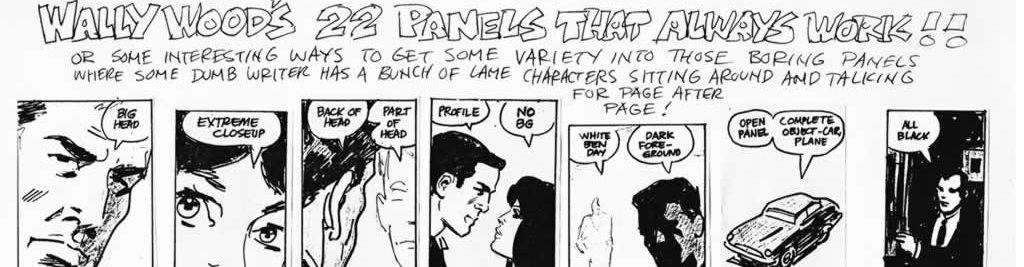
In Watchmen the divide between art/time/memory and reality is so blurred the notion of “life imitating art” is visible on nearly every page. On page 14 of Chapter 7 when Dan and Laurie first make love an ad for “Nostalgia” perfume is on the television in the background (“Unforgettable you”. Even the slogan is a line from a song about memory- Nat Cole “Unforgettable”). “Nostalgia” perfume is featured in several panels thereafter, page 25 in Chapter 7 a large billboard is visible in the background that reads “Oh, how the ghost of you clings….Nostalgia”. In Chapter 8 “Nostalgia” appears again on the cover page of Chapter 9 and on page 24 Laurie breaks a bottle “Nostalgia” destroying the complex structure that Jon built on Mars. It’s interesting that this product appears throughout the novel as a piece of the reality of their world, along with The Black Freighter. The reoccurence of these images ties in the emotional and violent turmoil of the characters. The Black Freighter, the ship of death, seems to parallel the nuclear holocaust lurking on the horizon. Memories also play a vivid role in Watchmen. Laurie realizes who her real father is in Chapter 9 as she re-lives a moment with a snow globe in her childhood. Memories have a real, however, abstract root in reality. On page 6 of Chapter 9 Jon explains that: “There is no future. There is no past. Time is simultaneous, an intricately structured jewel that humans insist on viewing one edge at a time, when the whole design is visible in every facet.” The memories of the past still exist in their own tiny worlds, like time capsules that re-play at the first suggestion of nostalgia.
Alyse Jones — First Readers, Watchmen chapters 7-9 — Laurie as a “real” woman
Chapters 7 through 9 really delve into Laurie’s emotions and push her to the limit and expose some of her grittiest character flaws.
In chapter 7, she practically throws herself at Dan because… he looks good without glasses?
In chapter 9, she is visiting/being held captive by Jon on Mars, and fails again and again to understand a damn word that he is saying. This bothers me because I understood what he was saying, and so did pretty much every other woman who has ever read it… so how does that represent “real” women?
It just made her seem unintelligent and completely irrational to me. She also failed to realize the point she herself had proven to Jon at the end of their conversation that convinced him to return to earth.
I completely lost touch with the character at that point.
I have two takes on her disposition —
1 (my initial reaction):
Alan Moore is sexist and wrote only weak, annoying, stupid, slutty female characters into The Watchmen. >.<
2 (my conclusion after a little more reflection):
As I stated in a previous post, The Watchmen seems to be an analysis of what would happen if real people were to try to be superheroes. In doing this, it explores various character types and their defects. For example, on the male side, you have an overly aggressive character (Rorschach), a cynical character (Comedian) , a self-doubting character (Nite Owl 2), a power hungry character (Ozymandias), and an indifferent character (Dr. Manhattan). This stretches into the Minutemen as well with insanity, etc.
The primary female flaws are shown through the fewer female characters. Three dangerous/tragic paths and faults that women are often accused of are: becoming whores (Silhouette), having illegitimate children and losing careers as a result (Sally), and making decisions based on wild, random, and unchecked emotions (Laurie).
So, considering Laurie's annoying character flaws alongside the other characters' flaws, she is a little easier for me to swallow. I do maintain, however, that such a woman – as well as the type of woman that Sally was – would not have been drawn to being superheroes in real life. Perhaps the fact that Laurie was “forced” into it has something to do with her disposition?
I also wonder what kind of social experiment the book would have been if a woman had been thrust into Jon's omnipotent superhero position rather than a man.
Dr. Manhattan: The Superman Exists and He’s Human
In Chapter 6, the complexities of Dr. Manhattan as a supernatural being are explored further. While searching for more in-depth character analysis of Dr. Manhattan, I came across this blog post by Dave Jones on thehogshead.org (which is primarily a Harry Potter blogging site, but still a particularly good analysis). Jones describes Dr. Manhattan’s talk on Mars with Laurie as his realization about humanity through perseverance in the face of adversity that leads him to “a strange moment of poetry.” As the God-figure, he is humanized in his escape to Mars and his sort of, stumbling upon a miracle in Laurie. I think the post does a good job of connecting Dr. Manhattan’s detachment from humanity as a recognition to his own humanity.
First Readers Leon Langford Watchmen Mr. Mason
Chapters 7-9 of Watchmen was a great blend of chapters that focused on character development, and keeping the plot moving seamlessly. I’d like to focus on the end of Chapter Nine, where Mr. Mason, the previous Owl Man, is killed. This scene was not in the film, and I have had little quality time to digest the reasoning behind removing this from the film.
First let me discuss the importance of this scene. Though it only last through pages 27-28 it really captures one of the important themes of the story: The good old days and how they relate to today. As Mr. Mason is attacked by the angry thugs who are enraged that the masked vigilantes have sprung Rorschach from his cell, there are several flashbacks to Mr. Mason’s earlier days. These were days where he could take on an angry mob and dispatch them with a smile. However as we read here, it doesn’t turn out so well now that he’s older. It really captures the ideas of past and future and the people caught in between. The scene doesn’t just relate to the previous Owl Man but to the ‘current one’, and the rest of the heroes who are all still trying to recovery a sliver of their glory days.
This scene could have easily been put into the movie (and whose to say it wasn’t when the DVD comes out with deleted scenes). But in the final cut, I think it could’ve worked really well to give us more of an emotional connection to Daniel, as well as to show us that the director is not playing around and that these characters deaths are right around the corner and we won’t be aiming for an everybody goes home happy ending. Watchmen the movie can only be as good as the source material, and even skipping 1-2 pages in the comic can have dire results for the movie.
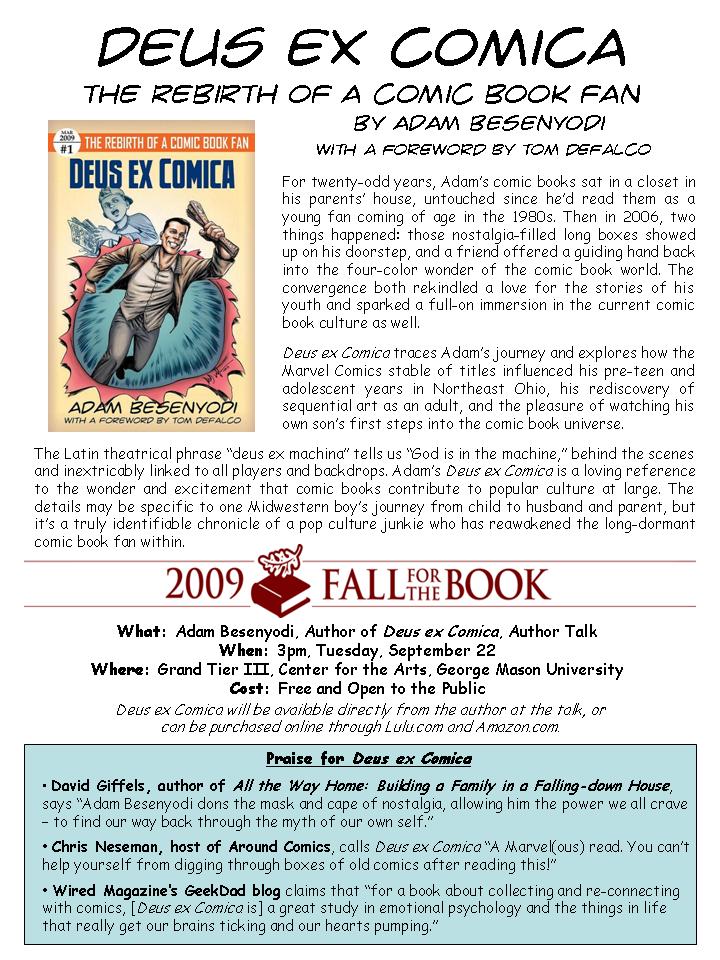
“Deus ex Comica” and Fall for the Book
Don’t forget that instead of our regular classroom, ENGL 493 will be meeting at a Fall for the Book event in Grand Tier III of the Center for the Arts at 3pm. We’ll listen to guest speaker Adam Besenyodi talk about his book Deus ex Comica (larger version of the poster below).
First Reader (Group 3) : A Look at Laurie
When reading The Watchmen, the thing that jumped out at me was that Laurie (the Silk Spectre) was everywhere, both physically and emotionally. In the physical sense she was in various places. She was in New York, then she went to Mars with Jon (Mr. Manhattan). Emotionally, she could not keep herself together. She had just left Jon and she goes to Dan (Nite Owl) and sleeps with him then goes to Mars with Jon as soon as he shows up again. All the while trying to figure out what she wants. I think a reason why she is everywhere is because when she was growing up she could not be herself. She was groomed to follow her mother’s footsteps even though she did not want to.
Since Laurie was unable to choose want she wanted to do when she was growing up, she does almost anything she wants now that the Keene Act forced her to retire. She choose to stay with Jon. She choose to break up with him. She choose to go to Dan and many more choices thereafter. Even though she makes all these choices, they seem to lead her to trouble. To me it almost seems as if she can’t make a decision on her own without getting into some sort of emotional trouble. She’s a thirty-five year old woman and I see a teenager that thinks she can do anything but pays the price for it. As I said before I think the fact that she could not make her own decisions when she was younger effects the way she is now. Now she can make those decisions but they are immature decisions.
-Kimberly Stokes
First Readers: Regarding The Comedian
Reading through Chapter Nine, I found myself particularly interested in the developments of the Comedian as a character. Since it is his death that starts the book and his image (the smiling pin) that graces the cover, we know right off the bat that he’s obviously of paramount importance to the story, though he is dead in the comic’s active plotline–a fact that is mostly negated by the prevalence of flashbacks throughout the book anyway. Chapter Nine, however, reveals a side of him you haven’t gotten to see before this point.
Early in Watchmen we encounter Edward Blake as a symbol of a lot of the things that are frightening about superheroes: a power-hungry, forced-based individual with little qualms doing things that make him seem far more like a super villain than a hero. Now, though, we get a chance to see another side of him. He’s capable of what appears to be at least rudimentary fondness towards his daughter, and even perhaps the woman he tried to rape earlier in the story. His repeating of the “you’re beautiful… like your mother” line gives the sense that he holds Sally in some regard still, though their actual interactions are always rough in the books. Sally herself defends him some to her husband, saying that he was capable of gentleness towards her.
Edward Blake is not a sympathetic character. His insistence that he tried to rape a woman “only once” cements this again in the moment you might be tempted to waver a little and forget his horrific crimes. He is, however, a complicated one and an interesting one, striking a chord of reality that is a bit disconcerting. There are levels to him that his chapter makes you explore that make him less comfortable to hate him, and that just goes along with the genuine theme in Watchmen of nothing being entirely black and white… as much as Rorschach may see otherwise.
Respondent: Moriah Jones
In agreement to Moriah Jones’ analogy of the heroes and their disgusting twist of views on humanity, I would like to add the effect of these heroes to people around them.
Rorschach admits that he wasn’t always the “Rorschach”. He was aware of humanity and played hero under the mask. However his mask consumed his true self. The mask seems to not just have the affect on himself but also to those who tries to find the meanings inside the Rorschach mask. Especially in case of Dr.Malcolm, the change of his personality and view are so strikingly evident. On page 8 of chapter 6, Dr. Malcolm’s personality is described as “Nicest, most positive person”. However, during chapter 6, Dr. Malcolm’s positive view on the humanity begin to change as he attempts to fix Rorschach. Dr.Malcolm’s positive character is partially devoted to his wealthiness and the well beings of his social correspondents. However this begins to seriously crumble as he examines the inner side of Rorschach.
Dr. Malcolm thinks he is able to fix Rorschach, in the process however, he himself begins to fall and get sucked into Rorschach’s dark view of world. Dr. Malcolm slowly begins to resemble Rorschach. His detachment to his wife and the social life, and disabillity to distinguish what is socially acceptable or not(his dinner ending with disturbing stories), his weird obsession with Rorschach(as Rorschach was obsessed with proposed mask killer). As Rorschach says, on page 13, “I’m not locked up in here with you. You’re locked up in here with ME”, the watchmen portrays the society where heros are not heros and may even be a villain.
Response to “Under the Hood and Tragic Comedians” – Seth W.
I would agree and argue that all of the inter-chapter text serves to enhance the story and, in fact, operates as an intergral part of it. Watchmen is not one narrative, but a series of conjoined stories that only come together as the finished product when read and grouped together. The main sections of the comic are much poorer for the lack of supporting material; some would call it pace-breaking exposition, but in the long run, how much of a pace does the comic really have?
“Under the Hood” cements the point of deviation from the original timeline (what we’d call “the real world”), and adds what seems to be a voice of sanity in the midst of a collapsing world. It is part of Moore’s critique of comics and their characters, and probably the origin of the now-famous “no capes” trope, regarding Mason’s attitude towards Dollar Bill’s costume-driven demise, the victim of a marketing ploy. Comic companies strive for success in the same ways, sacrificing character development, story, and quality artwork for reader enticements (“This issue, someone DIES!!! Or maybe they come back to life. We’re really not sure anymore. Please buy it anyways!”).
Searcher: Article Discussing Differences Between Watchmen Graphic Novel and Film
http://www.aceshowbiz.com/news/view/00022337.html
The article discusses some of the plot/narrative differences between Watchmen in its original graphic novel form and recent film adaptation, which, if memory serves, most people in the class have seen. Reading about some of the points of departure between the two mediums I think can serve nicely to highlight certain moments of the narrative and spur thought about how these selected moments and scenes add to, detract from, or otherwise color the overall product. I also feel as though a story that gets transferred between different mediums can be worth studying to help understand the limitations and/or benefits of working within those respective mediums.
Deconstruction and Realization of The SuperHero
http://www.unm.edu/~ithomson/Hero.pdf
The university of New Mexico had this really awesome PDF file of a short article written about Watchmen and the superheroes within it. It displays the de-familiarization of the normal superhero in our eyes and shows how Watchmen in a way made superheroes not only slightly more popular but also more uncanny and real version of these superheroes. The article hits on points of the deconstruction of the “normal superhero” but also the unhappy realization of fantasy and and fantasy characters.
one of the best points of the articles is that the philosophy of “idea is destroyed by its own realization” can be shown in the superhero, and the realization of the superheroes in Watchmen where “the hero is destroyed by the superhero, who is more heroic than any hero, but whose extreme heroics are no longer recognizable as heroics ” which all in all is the basic concept of Watchmen.
Searchers: Feasability of Dr. Manhattan
Well i managed to find a few links that might be interesting, so i figured that i’d include them all.
This is a letter from the producers of the movie version of Watchmen, basically giving their point of view on the transferring of media. He talks about why it took so long to get the movie of the ground and the difficulties of filming an “unfilmable” graphic novel, because of lack of support, 911, etc.
http://www.scientificamerican.com/article.cfm?id=how-accurate-is-watchmen
This was released right before the movie came out, and its a scientific look at just how possible the stuff in this movie/comic book is. I just think its interesting how the perception has changed from comic books never being taken seriously, to being taken seriously to the point that movie execs and scientists alike are worried about scientific credibility.
http://latimesblogs.latimes.com/herocomplex/2008/09/alan-moore-on-w.html
Interview with Alan Moore, telling his view on Watchmen and how it was strictly for the comic book medium, and a little more information about him, and other past and future projects.
searcher: watchmen related things
http://www.youtube.com/watch?v=FddtfNWJ0E
Sorry I’m not really sure how to post youtube videos as videos, just copy and past the first 2 urls.
Basically, these are videos from conventions ( I suppose) and this artist is amazing! He is creating a watchmen mural in chalk. His attention to detail is amazing. Anyway, that’s just something I wanted to share.
This however, is my related pick:
http://www.youtube.com/watch?v=3zPIJhtYo8k
This is clips of panels set in soundtrack to a Bob Dylan’s song. It’s relevant because the lyrics correspond with some of the panels and our book does have little panels with lyrics “at midnight all the agents”, etc. There is a parallel between the song and the graphic novel, and I think the story’s progress is shown through the song.
-laura kelly
Masked Heroes in Real Life: “Master Legend” – Searchers
http://www.rollingstone.com/news/story/25020634/the_legend_of_master_legend
This is a long article (definitely worth the read) from Rolling Stone about masked crime fighters in real life. The article features Master Legend and his sidekick Ace, who wage war against the powers of evil, in the Orlando, FL area, specifically. Master Legend reminds me of the “self-made” heroes from Watchmen like Nite Owl or Silk Spectre.
“Like other real life super-heroes, Master Legend is not an orphan from a distant dying sun or the mutated product of a gamma-ray experiment gone awry. He is not an eccentric billionaire moonlighting as a crime fighter. He is, as he puts it, ‘just a man hellbent on battling evil.'”
Master Legend’s crime fighting uniform is made of puncture proof rubber, although he admits a knife has never been close enough to test the material. His “Batmobile” is his trusty 1986 Nissan pickup truck. There are other heroes like Master Legend, living in our midst, many of them are listed on the “World Superhero Registry”. Some heroes are even police-sanctioned and in communication with police officers and chiefs all over the country.
“If there existed a Master Legend Issue 1, it would flash back 26 years to his origin story in New Orleans, where the teenage hero’s identity was forged in poverty and abuse. ‘My momma and daddy were not good people,’ he says. ‘Through them, I saw how cruel the world can be.’
To be honest that last line made my stomach hurt, I wish Master Legend would publish an auto-biography.
Searchers – An Informative Collegiate Paper on Watchmen
http://watchmenanalysis.blogspot.com/2008/08/wesleyan-university-honors-college_1443.html
This is a thesis paper I came across while searching for Watchmen related things…I think this is a helpful resource because it gives us the thoughts and opinions of another college-level person, but in a formalized way, so it’s not just some kid rambling on about comics. I found it quite informative.
Sorry guys, I didn’t know how to make the url into a link 🙁