The blog is new media too, right?

I’m going to talk about Uncomfortably Honest and Honestly Uncomfortable today.  This is a blog found at http://karencordano.blogspot.com/, written by a high school friend of mine.  Compared to some of the electronic literature and games we’ve been studying, I’m not sure that a blog really fits the bill.  But it’s such an important new genre, and one of the few that I feel comfortable with, that I wanted to discuss it. 

In her blog, my friend Karen discusses the challenges of motherhood, often as they relate to her sometimes paralyzing anxiety disorder.  The subject matter is highly personal, and true to its name, it often makes me uncomfortable.  The diary-like tone adopted by many bloggers makes me feel like a voyeur reading something secretly, and I don’t like the feeling.  I’m a private person, and I don’t have a lot of sympathy for people who tell-all.  In our culture, however, telling all is the norm, and not doing so can make you seem like a Luddite.  When Karen’s 2 October 2012 post discusses her body image and especially her fat calves, I felt profoundly upset.  This is a concern that any woman can have, and had I read this in a magazine article written by a stranger, I would have sympathized.  But because I know Karen, I was embarrassed for her.  I wanted to shush her lest someone unkind overhear and make fun. 

This got me thinking.  Karen chose to expose her fat calves to the world.  She must not be embarrassed by them in the same way I am.  Sure she’s embarrassed, that’s what the post was about.  But sharing them with the world is within the realm of possibility for her.  And that means that there are other things that are not within that realm.  I started wondering what Karen doesn’t blog about, and I realized that even something as highly personal as a blog is exquisitely crafted to present a persona—and not just any persona.  It presents the persona the author wants you to see.  So Karen is happy to be seen as an anxiety-riddled mom with fat calves.  And that’s who she is.  But there is so much more to her that she can never express on that blog, yet the blog reduces her.  Instead of making me more comfortable with the genre, it makes me more suspicious.

Choose Your Own Adventure! Sorta

The Dreamhold seems like a scary place to a person that is unfamiliar with what it is. The reader/interactor/player/narrator – what is the proper term anyway? – wakes up in a cramped space with only a narrow gap to escape from (I almost got stuck because I could not figure out the phraseology to climb out). My mind immediately went to the movie 127 Hours. I definitely did not want to cut my own arm off, even in interactive fiction land.

The evolution from last week’s digital poetry to this week’s interactive fiction seemed logical. We keep comparing everything to “Choose Your Own Adventure” books, but this interactive fiction truly embodies the example and then takes it so far beyond. No two stories could ever look the same (ok, I’m sure there is some small sliver of a chance). The story does not exist without the reader (we will call it that for simplicity’s sake) and the story obviously does not exist without the writer (ok, now what do we call this person? Writer? Creator? Coder?). This interactive fiction takes us back to last week’s discussion regarding where the story truly lies – in the code? In the story that particular reader creates at that moment of interaction? Every new step creates a new story – or does it? Is it only complete when the reader closes the program? Who is the writer? Is the reader the writer? If so then we cannot refer to them as the writer any longer. Montfort helps makes sense of this slew of questions by deeming interactive fiction the ultimate fusion on multiple genres. I agree in theory, but with The Dreamhold, I became frustrated because I still felt as if I was being led to do certain things. I also felt like it wanted to say no and deny my actions as much as possible. It kept telling me my singing was bad! I cannot even pretend like I can sing in interactive fiction land?! It just seemed wrong. I thought it lacked the freedom of expression that seems to be an emphasis of interactive fiction. While interactive fiction is indeed a fusion, I’m not sure it is the ultimate fusion, mainly due to its limitations. Despite that frustrating aspect, it is truly of value to play with the idea of reader, writer, observer, creator and the many other roles that could be a part of interactive fiction. This play can help the audience and interactors better understand other forms of literature that do not fit the traditional mold of normal literature.

The Hitchhiker’s Guide to MUDs

When I was a kid, one of the few games I had for my Commodore 64 was a cracked copy of The Hitchhiker’s Guide to the Galaxy. I was a huge Douglas Adams fan, and I should have found this game amazing in every way. The only way I found it amazing was in how amazingly frustrating it was. Even with a supposed “guide book” in hand, I found the game not only unbeatable, but practically unstartable (I never did get the babel fish).

Fast forward a decade or so to my first time away to college when my roommate introduced me to the internet, and in particular a game called Purgatory. It was a MUD, a multi-user dungeon. The interface was just like the text-based games I had played so many of in my youth, but it was a completely different experience. Where those games had been restrictive, this one was liberating; where those had been fun but limited, this one was grand and unlimited. Most importantly, where those had been professional and polished, this one was completely amateurish, and it showed.

Hitchhiker’s had a defined, linear path to victory, and when the story was over (so I’ve been told) it was over. There was also no real way to access help; even the guide book was more use as a coaster than a reference. Purgatory theoretically had an end game, in that once you reached a certain level of accomplishment (and I came so close…) you became part of the creative team that expanded the world rather than playing in it, but nothing prevented you from continuing to participate.

In addition, the paths to reaching that level were as varied as you wanted them to be. You could explore the world in any order you liked, and new sections were being added all the time. They ranged from the traditional, generic fantasy to more obviously plagiarized but still fun fantasy (including an entire section based on David Edding’s The Elenium series) to the bizarre (my favorite zone was based on the Rush albums 2112 and Hemispheres. No, I’m not kidding.) This level of playfulness and creativity was added to by the element of roleplay and interaction with other players, many of whom would willingly assist new players to adjust or advance.

As I look at The Warbler’s Nest and The Dreamhold, I am reminded more of Hitchhiker’s and less of Purgatory, although the feeling of both of those is more of a purgatory than anything else. While the writing feels tight and defined, parsing the story and figuring out “next steps” is often more struggle than entertainment, and the lack of visual or audio clues in the absence of a friendly group dynamic is a flashback I can easily do without.

A Facebook Book

Maybe not so ironically enough, I first read about Matias Viegener’s 2500 Random Things About Me Too via social media. The book was written on Facebook, and relays an experiment on the construction of identity in a “Facebook-drenched world of self-manufacturing and short attentions spans“; a statement that our class could argue with. The book’s publisher notes that it may be the first published book entirely composed on Facebook.

Viegener wrote an article for The Huffington Post, “How I Wrote A Book On Facebook“, about his process. He claims he didn’t have any intentions on composing any kind of notable literary work when he began posting random things about himself in response to a Facebook chain letter. He notes that he wanted to start his own list of random facts about himself, but randomness is not random if it is focused on, which relates to ideas from Burroughs article about The Cut-Up Method. The idea for a book came symptomatically from the amount of feedback his post got from friends, relatives, and acquaintances. His text unintentionally took on a dialogical form, his Facebook community was actively implying and inferring information. This exchange of information and experience inspired the book. In this way, he uses a version of the cut-up method by choosing which among the comments should be inserted into his story.

In Viegener’s article he includes an excerpt from the book. The text of the book takes the form of numbered lines, clearly meant to count the 2500 random things. Using the background information Viegener provides about his process, it’s possible to see how each number could represent a different person who was participating in his Facebook post. The chosen sentences seem fragmented, yet they have a cognitive flow. I thought Viegener’s process correlates with our class, although the product is a physical book, because he utilized the link between technology and society, as well as the connection of seeing and writing, which we read in Bolter’s article. The flushed left sentences create a lot of space on the page, space that is traditionally used up by paragraphs of text to tell a story. Since the story was formed through conversation on Facebook, the space conveys a metaphorical space between thoughts/perspectives. His work is different from the digital works we’ve been discussing because he doesn’t keep his platform constant with his process, but does that make it lesser? I lean towards yes because if he had chosen to publish this as digital literature, he would have been able to build upon it and make it active, as social media/the Internet is, instead of freezing the story in a physical medium.

Hypertext Gets Wet

How does Stuart Moulthrop’s Deep Surface work? What a difficult question for a non tech-savy student like myself. Technically speaking, it’s an interplay between “a reading machine and a free-diving simulator.” This relationship creates a metaphor for the submersion of oneself into reading  (a book and pages on the web). The “deeper” we go, the more dangerous it is. This applies in two ways in Deep Surface.

The farther you go down into the water/bring your air bubble down the page, the more dangerous information the player finds. The deep refers to the dark and disturbing words that appear. The words closer to the surface are less disturbing. Secondly, the farther you go down the page/into the water, the less air you have to breathe and the closer you are to dying.

Luckily, not much is taken away when you die because you can start over again. Unless of course, the points, accumulated by returning to the surface in time to get air, and winning mean a lot to you.  Personally, I died quite a bit because I wanted to get to the bottom to read the more dangerous and disturbing information. More often than not, (perhaps because of slow computer that couldn’t make the works come up fast enough) I died trying to go back up to the surface. I don’t think this adaptation by the game was made by chance.

Moulthrop purposely made it difficult to thrive in the deep of his word pool. It enhances his metaphor by saying that there are more risks, but also more interesting information the farther you dive/look into reading.

Moulthrop also allows the player to access information from separate sources easier than one would be able to find in any other medium. He makes Deep Surface into another literary dimension where the player is able to “dive gradually from one plane of presentation to the next.” By presenting it this way, we’re able to travel from one piece of information to another as if gliding in water. Despite slow computer technical difficulties, I think any player will have to think about Moulthrop’s electronic textuality and the modalities of reading because of Deep Surface.

Ah, memories.

Growing up, I was always told to go put down my Game Boy, Game Gear, Super Nintendo Controller, go read a book, or go outside. Now, nine out of ten–I didn’t, I would remain diligent and complete my quest; get to level 8 of Super Mario Bros; try another left field strategy for that one cheap-ass boss that just always seems to get the leg up on you. I wasn’t a complete hermit after all. I did read, played outside–with friends, but gaming was my passion.

Tailspin by Christine Wilks tells the story of an old man dealing with tinnitus, a condition that effects an individuals perception to sound. The story also includes his daughter, Karen, and her two grandchildren, who are playing a “dammed annoying game.”  When you begin, you see small, whirling circles–going either clockwise or counter–outline the shape of an human ear, more specifically, the inside of the ear. As you move the the arrow to one of the circles, you get a snippet of the story. Repeating this will prompt a blue circle to appear in the middle, allowing you to go deeper into the story, or in this case, the ear.

What’s interesting in this work is a number of things. For instance, as you move from circle to circle, they fade out and become gray. This could symbolize the old man’s hearing is fading, and perhaps those annoying sounds from his grandchildren’s handhelds are becoming even more faint, which upsets him further.

The story itself has no particular order. To elaborate, remember those whirling circle mentioned earlier? Well, there is no specific order of those snippets–you can guide the arrow to the circle of your choosing. Maybe this is how the old man, or grandpa, perceives sound; his ear processes particular sounds at certain times, and throughout the story, this really ticks grandpa off, all he can hear is, again, is that “damned annoying game.” In a sense, this work reminds me of my upbringing–just a little.


Waking Up in Words

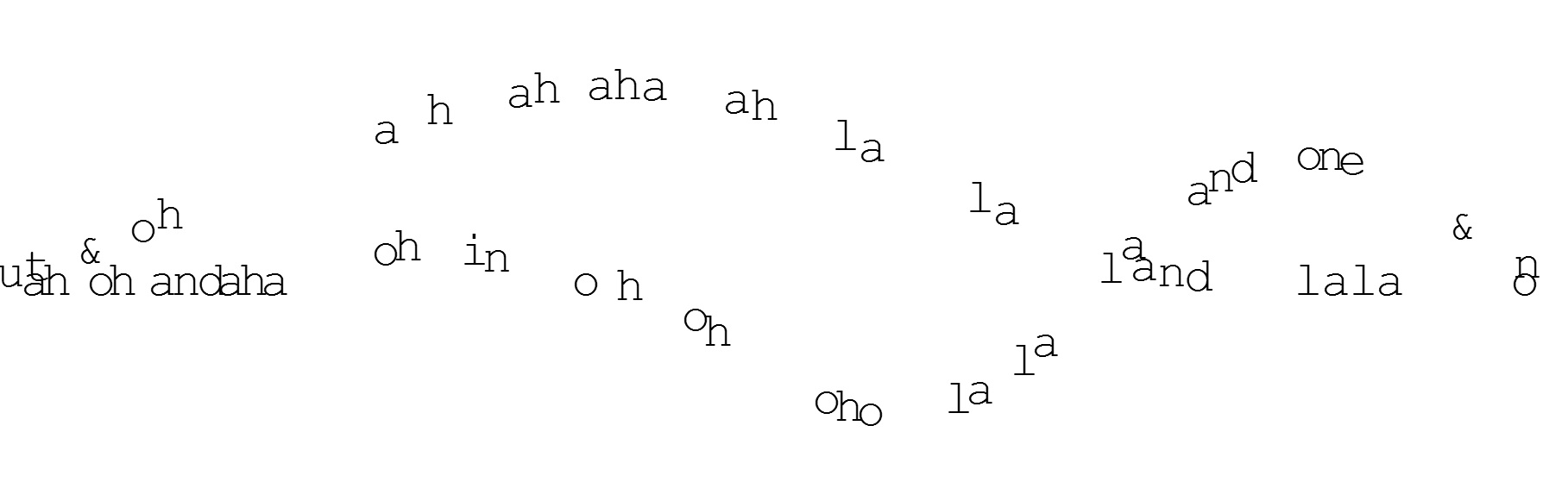
The first thing most people do when they wake up in the morning is take a shower.  While the process seems somewhat involved and meticulous—shampoo hair, lather loofah, remember between the toes, etc.—the body is pretty much on auto-pilot, running off of the familiarity of an everyday process, while the brain is still struggling to wake up.  At this point, at least for me, it is almost impossible to produce a single, discernible thought; waking up is a process.  Ah is a digital and visual representation of this evolving stream of consciousness.

The program presents itself as a horizontal, linear, scrolling “marquee” of letters and words that can overlap and pass those preceding it.  The first letters seem like a random display of a’s, h’s, l’s, and o’s that overlap one another, but then quickly scramble into a song-long arrangement of “la”s and “oh”s: the morning’s first attempt at conscious thought manifests as singing in the shower.


The level of complexity of the letters increases, mingling into whole words that sometimes compound into sentence fragments.

But what’s really interesting is that even though the content has become more complex, the stream of consciousness associated with it still remains linear and muddled.  Letters and words are still able to overlap and/or race past one another.  In the sense of waking up during a morning shower, an individual becomes increasingly able to formulate complete thoughts after the passing of some time, however their mind is still one-tracked and still finds it hard to differentiate between one thought and another.  This sense is inflicted upon the reader who is trying to made heads-or-tales of the words scrolling before them.  The “narrative” projects the waking-state of the showerer’s mind onto the reader, who in turn is made to feel disoriented and nonsensical.

Once the brain awakens and becomes functional, the linear format that represents the stream of conscience is abandoned and is taken place by a double-helix sort of shape.

The mind is now capable of multiple streams of thought, which range from the “oh lala oh la oh” singing to contemplating Einstein and the manifestation and passing of time that has occurred during the shower.  Letters, words, and sentences are more easily discernible and both the mind and the viewer can comprehend them more easily.  A question to ponder, however, is that after struggling to find meaning within the previously muddled thoughts, is it the stream of consciousness that has cleared up, or is the mind, the showerer, the audience that are now more adept at reading between the lines?

“This is the story of life: 5 potatoes began it all, 3 without fire, and 2 with fire.”

Well, I made it to the end of the game, game, game, and again game, and, being the greedy bastard that I am, took both the winnings for MYSELF!!!! I won’t spoil the reward for you all so I will keep my little mouth shut. Let me just stay, that it was the most beautifully dysfunctional game that I have ever played. Everything in it was confusing and left me asking questions. Why am I a little fuzz ball? What is this poem that appears when I collect the various tokens in each level? What are these creepy yet intriguing/nostalgic home videos that I unlock in each level? The home videos are on loop and play over and over, I try to gather meaning from them. But I can’t; instead, I just give into the experience and travel through the game to the end, where I greedily take both winnings that the game offers me: big winnings, and small winnings.

The game seems to acting in the way of absurdity. Even though there is all this odd shit making my head hurt, I still can see a sense of narrative or progress: it’s murky, but it’s there. It’s there as I move through the game, through each of the 13 levels. The game combines poetry with video and interactive game play and weird sounds. My god, every time I press the space bar while writing this the little fuzz ball guy jumps because the game is still on in another tab and the sound is like a frog being splattered under a slow moving tractor.

I know that the poetry and the videos have context, but I have none to place them specific to them, I have only my own sense of context in which to place them. They  are here in the game for me to not understand, but to experience. The final video that I receive at the end from the big winnings option begs me to realize that there is no meaning in this  piece of new media, it’s just an experience immersed in ambivalent feeling and emotion connected with the dysfunctional. But then, the narrative at the end makes me compare it to the story of the game. Are they one in the same? I try to attach meaning to the story because that’s what we humans do. Beneath the frozen pudding. I don’t know if the story of life is hiding under the frozen pudding, but I am glad to have thought so. Jason Nelsons creation of new media was both awesome to experience and absurd.

Stand and Create

Upon reading Ryan’s Dysfunctionality in Digital Art article, I began to critically examine each of his four types of dysfunctionality, particularly at what he calls “Ludic” functionality, namely asking, “what can I do with this technology, other than what it was meant for?”
Then I came across this piece, by Bruno Nadeau and Jason Lewis:
Still Standing

This piece, as well as its similar referencing artwork, Text Rain, by Camille Utterback, seemed to me a prime example as this use of dysfunctionality in the digital realm. In the Still Standing piece we see that the person viewing it interacts with a seemingly random group of letters on a screen. These random letters, bumbling along the floor, then move accordingly as your body physically moves across the projector area in a way that replicates the letters actually running away from the person. Contrary to other interactive motion technology uses, the only way to interact properly for with this piece to make sense is to stand still, when the projector senses your silhouette and forms the letters to make words in that exact shape so you can see your own “shadow,” in a way, as well as the words forming a poem, and not only that but one about the increasing pace of our society and the necessity to keep up. Thus, through the use of dysfunctionality the artwork is displaying its message both literally as the letters toss to and fro on the screen and mentally as we attempt to relate to the piece and see how it functions. The creators Lewis and Nadeau have in effect turned the use of motion-sensing and turned it on its head, because in order to actually understand what the piece is actually saying, you have to be motionless. The message is portrayed through a seemingly random process and its solution is counter-intuitive to the user interacting with it. Otherwise upon initial interaction the piece may just seem like another technological exhibit in a science museum. Similarly (and originally), Utterback’s Text Rain plays with the use of motion-sensing technology by once-more throwing seemingly random text and having them fall from top to bottom, like rain drops. As they approach the user’s shadow, they land and also slowly begin to form words if enough of a shadow or interaction of the camera is captured. Thus the dysfunctionality actually portrays a message, in this case another poem:
“I like talking with you,
simply that: conversing,
a turning-with or -around,
as in your turning around
to face me suddenly…
At your turning, each part
of my body turns to verb.
We are the opposite
of tongue-tied, if there
were such an antonym;
We are synonyms
for limbs’ loosening
of syntax,
and yet turn to nothing:
It’s just talk.

Amor De Clarice- The Limitless Applications of Digital Media

Rui Torres’ “Amor De Clarice” demonstrates the limitations of printed media while simultaneously illustrating the boundless limits of digital media to recreate text. Excerpts from “Amor De Clarice” are exemplified as the hypotext in this piece of electronic literature. The hypotext is placed on a static background without movement. In contrast, the hypertext (links readers can click on that illustrate different poems), is extremely animated and interactive, exemplifying the seemingly endless possibilities digital media offers. Readers can click on the hypertext, whereas the hypotext remains stagnant. Audience members are shown that digital media can provide rhetoric and meaning of which printed media is incapable; the meaning of the text is strengthened by the digital platform as readers can connect with other perceptions (such as sound, moving pictures for visual illustration, color, etc…) that enhance the text that was once inactive.

Additionally, the hypotext is in the background while the hypertext overshadows the original text, illustrating a temporal representation of printed text as being improved upon by digital media. The hypertext moves back and forth across the page, inviting users to click on different poems. Each line represents a poem that links to a different video; the videos directly correlate to the poem’s message and act as a visual aid in understanding the text. Since individuals learn through sound, sight, and touch, electronic literature affords readers the ability to read, listen to, interact with, and visualize the text. The use of hypertext in this electronic literature illustrates the numerous ways in which digital media can enhance the rhetoric of literature. Readers can even alter the meaning of a poem by dragging lines of the poem into different locations on the screen. Although the poems’ rhetoric was originally evidenced through textual reading, readers can now understand the poem more deeply through the use of video, image, and sound; the videos and images of each poem represent and enhance the meaning while simultaneously creating new meaning.

While the poems are not written in English, the implication of digital media as a beneficial medium for electronic literature is evident. The original text is incomprehensible and concealed by the hypertext; it is laid on a dull background of gray and black, further indicating the limitations of printed media. In contrast, the hypertext allows users to interact with the text, clicking on poems that connect to images and reinforcing the meaning of such poems. The videos and images represented are colorful and active, representing the dynamic effect of literature through a digital platform. “Amor De Clarice” demonstrates the nature of process (as technology is always moving forward and is not static) and interactivity (as readers can click on different lines of text).  The ever-changing hypertext represents the process by which digital media enforces the creation and recreation of a text as the text is always changing to match the current technology.