Everybody Dies

While I was wandering though the first and second volumes of the electronic archive, I found a text based adventure game (interactive fiction) called Everybody Dies. Intrigued, I downloaded the game and began to play it. The differences between this game and other interactive fictions games (The Baron, Aisle, etc.) is how strongly characterized each person is. The perspective starts with one character who resists your commands and complains the entire time. After he dies (because everybody dies), the perspective shifts to another character, and so on as everyone dies off. Really, each of the characters illustrates how pointless life is and how each one is bogged down by petty concerns that become irrelevant in the light of their death. It also makes clear how easy it is (apparently) to die. All of the characters are focused on themselves and their own goals, and in a lot of the death circumstances, that self focus results in their deaths.

A lot of the death were incredibly detailed and interesting, but what interested me most was what happened after they died. Until in most interactive fiction where death means the game restarts at the beginning, death doesn’t end the game. The game continues on in a “void” before slowly transitioning to the next character’s thoughts. While death seems inevitable, by creating a void as a transition because characters, there is a sense of reincarnation and how all these people are truly interconnected, whether they see it within themselves or not.

The last thing that stood out to me about this game is how similar it is to an interactive fiction game I made two years ago for a different class. The game I built was called “Survive” and it focused on one character exploring an abandoned church and being forced to die again and again in increasingly bizarre circumstances. I had never heard of “Everybody Dies” at the time, but I can’t help but see how well the game is coded and how the structure of multiple characters makes the insane death much more tolerable for the game player. In a lot of ways, my game was punishing to the player, but this game is not. Even death isn’t the end. Life continues on. And I think that was the main thesis of this game.
“We drank and insulted each other’s mothers.”

Young-Hae Chang Heavy Industries’ (YHCHI) “Dakota” is a re-telling of Ezra Pound’s Cantos I and II as a drunken ride though one of the two Dakotas (the artists do not specify)…but you wouldn’t immediately know that to see it. Nor is it important to the artist or the understanding of the piece that the viewer be familiar with Pound’s work (though it is a fitting use of Pound’s own dictum: “make it new.”) The animated black text (available in English, Korean, Spanish, and Portuguese) flashes across the white screen in step with highly syncopated jazz drumming, eventually punctuated by the exuberant hollering of band members as the piece escalates towards its conclusion. The effect is a kind of dizzying digital beat poetry (that, after the repeat viewings required for critique, leaves the same visual echo as staring too long at a light…and a bit of a headache.)
In an interview with Thom Swiss, YHCHI notes the “tendency to read quickly” online, perhaps limiting the length of text passages whether creative or critical. While the interview as it appears in the link isn’t dated, YHCHI’s joke that the need for small, instantly accessible clips of writing comes from a fear of receiving a big phone bill does seem to “date” the conversation. But even with flat-rate in-home Internet access, immediacy is still preferred. Lengthy posts on blogs or in discussion forums are occasionally dismissed with the comment tl;dr (too long; didn’t read). This may be seen now a result of the increased portability of screens made smaller and smaller. It’s physically difficult to read long articles or passages on smartphone screens.
“‘Dakota” resolves this problem of digestion by breaking up its narrative onscreen. The active “reader” of Pound’s poem becomes a passive “viewer” of ‘“Dakota” as it’s visually “read” to her. In a medium marked by interaction, YHCHI’s “Datoka” feels like a textual movie. Here there is none of the clicking common to other digital literature. The piece cannot even be paused (though the viewer can, by right-clicking, forward or rewind the piece.) The piece pushes back at the notion that the reader/viewer should physically engage the work on a computer screen. After a minute the stark contrast and quickening pace feels like a bombardment of information that is actually less overwhelming when transcribed (as the artists do elsewhere.) In this way, “Dakota” is marked by both urgency and distance. It’s as if the creators are daring the viewer to ask for more immediacy, taunting the reader who wants to see fewer words per digital “page.” In another piece on the group’s site, “ARTIST’S STATEMENT N0. 45,730,944: THE PERFECT ARTISTIC WEB SITE”, asks what else the artist could be doing instead of waiting for a large file to upload. “Read a good book?” it suggests back. Perhaps YHCHI wonders, on some level, if the reader/viewer may not be better off doing the same. “Dakota” is hard to watch because of the physical strain this seeming passivity puts on the reader/viewer.

Interactive Storytelling

Interactive storytelling is great. Not only does the reader get to immerse themselves into a digital world that tells a story, but in some instances, the readers participation can influence the entire story–beginning, middle and end– and its characters if the options are available.

In Donna Leisman’s “RedRidingHood,” the audience embarks on a playfully, but dark retelling of “Little Red Riding Hood.” In the work there are no words, which was interesting because if you think about it–there was no use for the words; the story is ubiquitous. We all know what happens to the bed-ridden grandmother; how the wolf looses his “lunch,” so the words would, in a sense, be a little redundant, to older individuals that is.

To elaborate, we could look at a picture book titled “Little Red Riding Hood,” open the book, see that there are no letters, and still know the story just by pictures alone because the pictures will tell the story in sequence as we mentally put the words with the pictures. Sure, we might not know the exact words of the story, but we have a general idea of what is being said in the story due to the repetitiveness of the story.

What I’m getting from the work is a new approach to tell the story of “Little Red Riding Hood,” but in an aesthetically unorthodox way. Some of the imagery in the work is extremely bizarre (Red Riding Hood can become pregnant–at least, I think she becomes pregnant–with twins given you select certain actions within the story, but this is where the work shows off its interactive storytelling elements. There is a dream sequence in which Red Riding Hood is asleep, participants can either awaken her, or allow her to “keep dreaming.” Choosing the latter will open up new story line possibilities, and for some, new interpretations of a story that has remained the same for decades.


Reaching beyond the screen

Traditional writing, music and film are restricted in one key aspect: they are completely linear. Even such luminaries as Pulp Fiction that attempt to break the temporal linearity of the medium are restricted by the fact that the finished product, no matter how out of sync the storyline might be, is still told in a strictly linear fashion that will be the same upon each viewing. “Redridinghood” by Donna Leishman (http://collection.eliterature.org/1/works/leishman__redridinghood.html) embraces the capabilities of the digital environment to elevate the narrative beyond this linear restriction, engaging the reader/viewer through interactivity.

While the storyline still has a defined beginning and end, there is a certain amount of flexibility built into how you get from A to B. Most of it is small and subtle, as little as lights in individual rooms in a skyscraper going on and off as the mouse icon hovers over them. However, even something as small as “click to continue” draws the viewer in, makes them complicit in the telling of the story. Even more significant, in the middle of the work there is an opportunity to make a key choice that, while it does not change the inevitable conclusion, does alter the narrative experience in a very meaningful way.

The artwork is simple, having a rough aesthetic at odds with the complex musical track and deep, thoroughly developed themes of the piece. Considering its age (it was created in 2001) it is hard to say whether this is an artifact of intent, artistic ability, or simple limitations of technology at the time. The color scheme is obviously deliberate, using stark contrasts, careful shading, and vivid lines to maximize the impact of the art. The piece also playfully blends traditional comic book esthetics with digital capabilities, using individual panels in comic book fashion while advancing the narrative through motion within the panels, and in some cases giving direction to the viewer through motion within the frame. The reader is “drawn in” in both senses of the word, invited to participate with mouse clicks that change the structure of the world and move the narrative forward or even sideways.

This expansive view of what narrative is changes the relationship between story, storyteller, and listener. It utilizes the capabilities of the digital medium to reach beyond the separation that traditionally exists between the creator, the creation, and the consumer to create a new dynamic, a gestalt work that combines all three.

Ode to A Computer

As is only appropriate, my creative response is the product of judging a book by its cover.  Or, rather, a digital work by its thumbnail.  And it’s true: a bright yellow light attracts the unsuspecting, FYI.  Separation/Séparation is an interactive piece created to illuminate and combat the ailments that result from extensive use of a computer.  The author specifically addresses RSI, Repetitive Strain Injury, a term that addresses a state of both physical and mental exertion.  While the body may hurt from the innumerable hours spent slouched in an office chair looking at a computer screen, the brain has “bonded” with the machine and is incapable of really functioning without it.  As the author points out, the paradox of the program’s name is in the fact that “separating from the computer is painful, but to write with it again is painful as well.”  I myself have found irony in that users have to use the computer in order to reach this program that advocates for human/machine separation.

Anyways, the piece is a poem, an ode to a computer, that visitors have to click through to finish: the words of the poem appear one at a time with each click of the mouse.  But, BEWARE.  Clicking too fast, or what I considered to be a normal reading-speed, prompts the program disable clicking-abilities and detain you with a dialogue box that accuses you of not having “the right attitude in front of your computer.”  To make amends for your wrong-doing and before you can continue the poem, you must admit your sins by owning up to: clicking too fast; clicking with too much force; not having your eyes in the correct viewing position; or your muscles being too tense.  With every following speeding infraction or when you’ve come to a checkpoint in time, the program again disables your clicking-abilities and prompts you to put some space between you and the machine.  Stretch out your facial muscles, relax your shoulders and back, do some deep breathing- this is really heavy work you’re getting into.  You can get to the end and, once you do, you, the human, learn you CAN function without the computer.

As much as I’ve mocked it so far, the Separation program is actually pretty ingenious in reminding computer users to slow down, be conscious of yourself, and just BLINK every once in a while.  Tarleton Gillespie’s article “The Stories Digital Tools Tell” actually talks about “the consequences of technology” and how it’s difficult to perceive them before the fact because the tools “are our silent partners…with no agendas of their own” (108).  While Gillespie’s spin is particular to the politics of technology, her appeal to a technology’s consequences, affordances, and intentionality highlights how the use of a computer both aids and disables us.

Creative Response #1

In My Body by Shelley Jackson, the author is able to connect with the reader by using universal symbols as metaphors by creating personal stories involving the pictures the reader chooses. On the authors website, which includes a picture of a female body sectioned off by different body parts the reader is able to control his or her path to discovering the author by clicking on different pictures or words in the poem which lead to different stories. For example, if one was to click on the drawing of the author’s shoulder one would be directed to a story or memory that involves her shoulder somehow. Then one would have the option of clicking on various phrases or words in that story that relate to a monumental time in Shelley’s life when she was able to complete several more push-ups in grade school than the other children in her class or a moment that represents the inspiration for a tattoo she got later on in life.

                In one of the reading for this week, New Media Theories and Practices of Digitextuality, Tarleton Gillespie discusses meaning of tools in The Stories Digital Tools Tell. Gillespie’s discussion of the importance of the functions and politics of objects in media pair well with Shelley Jackson’s use of objects in My Body.  Shelley’s collection of poems, pictures and communication create an atmosphere in which the reader can be involved and relate to the drawings and stories they represent. In Gillespie’s article he discusses the use of an object or tool as a metaphor, where it is understood by various cultures because of its general nature, but can also be misinterpreted.  The general uses of objects have the potential to be misinterpreted because it allows the reader to create his or her own meanings behind the object. However, Shelley creates a more personal story and narrows in on  the ambiguity of the object by using a relatable and widely understood object, the human body, and focusing in on meaning and purpose of the body parts through intimate stories and memories.

Mary Barnes

Creative Response #1

According to the Electronic Literature Collection’s description of Robert Kendall’s kinetic poem “Faith”: “While the word ‘faith’ resists the word ‘logic’ at the beginning of Kendall’s poem, Faith has its own textual logic by which it progresses, words and letters rearranging to lead on to the next state.  This short multimedia piece mingles textual animation and sound effects such that a structure of words sounds as it forms or collapses.”  To add to this: Kendall seems to be using a sequential form to his poem to demonstrate the structure or progression of participating in the act of faith.  Thus, faith—which is supposes to reject reason and form—demonstrates a type of logic and configuration of its own.
Specifically, the author describes (presumably) his journey of faith through five movements in action: first he avoids logic entirely as the words fall from the sky and collide with the word “faith.”  This causes “logic” to vanish—almost entirely—from the screen.  Second, he acknowledges this avoidance of “logic” but tries to justify the need to do so: “Can’t the mind press around the bend to consummate this vision of the deep ‘or’?”  The words next to the forward button reveal doubt: “Maybe,” he answers himself.  “But…”  The next movement demonstrates the questioning of logic through the playful movement of the words: “winking neon” blinks; “theory” spins; and “button” sinks and rises; while in the fourth movement, he tests the use of logic only to conclude that his actions are not logical: “I step to the idea edge elegantly and oh so ultimately…upon the logic lip…I just can’t make the usual sense anymore…”  Lastly, the fifth movement displays an acceptance of faith: All the words of reason which demonstrated this progression of understanding crumble to the bottom of the page.  The word “faith” which stood solidly, fixed at the top now drifts down to crush the fallen ideas below.  The movement of these words represent the lofty, untouchable “faith” that has outstood all other things, is now an accessible idea—as it has dropped to the level of understanding or reason.

Creative Response- “Endemic Battle Collage”

The Endemic Battle Collage (http://collection.eliterature.org/2/works/huth_endemic_battle_collage.html) is a set of digital poems created by Geof Huth, which was displayed in the simple style of the original Apple Basic program.  While it is indeed a form of poetry, at times the images challenge this idea.  For example, at one point the screen fills up with repeated lines of only the home key letters.  While Huth then transforms these lines into actual words, the typing out of the home keys reminds those viewing his work that they are not simply experiencing a poem on a printed page in a manner that they are used to.

The computer-poetry link is further reinforced by certain sounds which happen at different intervals of the poem.  At some points, the sounds make sense, such as the repetitive tapping sounds that accompany the appearance of the word “thread” on the screen, and which put the viewer in mind of the sounds which might be made by someone who is sewing or knitting.  However, at many points the sounds are simply random, robotic beeps which do not emphasize the words that they are accompanying, and which seem to only be there to again reinforce the idea of the link Huth is making between a literary work and a digital form of communication.

In this way, it seems that the Geof Huth is both critiquing modern poetry, and at the same time putting his own spin on it.  Many contemporary poems can, to some readers, seem to be random collections of words with no meaning, which he imitates when he flashes not only random words, but even random, disconnected letters across the screen.  At the same time, he is furthering modern poetry by taking it from the printed page to the screen.  This allows him to use poetic elements such as imagery in a different way; for example, the word “inchworm” slowly grows and moves across the screen in a way that resembles a living inchworm.  It is also fitting that he imitates more modern poetic styles on the computer; the effect of his digital poetry may not be the same if he had tried to type out and imitate older poetry styles such as sonnets.

Through the use of both typed words and computer-generated sounds, Geof Huth manages to move modern poetry to the digital screen, and offers viewers a new way to immerse themselves in the sounds and sights of his modern poetry.

The Infectious Emotions of New Media Literature

In Donna Leishman’s Deviant:The Possession of Christian Shaw, Leishman captures the viewer, or player, from the moment she/he begins this story. I was immediately swept up into the life of Christian Shaw, a girl that just appears to be depressed at the beginning, and later turns out to be possessed by some sort of demon. This particular piece of media, however, does not make it easy for the viewer to interact with it. It is not immediately obvious as to what you should do or what the goal is. After aimlessly clicking on everything for a minute or so, something finally worked, as the screen zoomed in on one of the buildings in the setting. At every step, though, it took quite some time to move forward. I spent about an hour on this particular piece, and I never came to any conclusion. This got me thinking that, perhaps, the difficulty in navigating this is possibly more the point of this story than the actual story of the character, Christian. It is clear that Christian Shaw is having a hard time, but the difficulty with which I had in moving forward in the story is what truly made me connect with Christian. I became aggravated, angry, and slightly disturbed in a matter of five minutes. Not only was the layout difficult, the images and the music pulled me into these odd feelings. As I interacted with Christian more, I became increasingly aware that she seemed to be feeling these emotions as well. So, perhaps, she was not the one feeling my emotions, but I was the one that was relating to her, through these emotions evoked purely from the layout of this piece.

From this piece, I begin to think that new media is a new (no pun intended) way of evoking emotions from the viewer. I’m not suggesting that this is a better way of evoking emotions than regular literature, but it does seem that new media literature can evoke emotions in quite a different way than a hard copy of literature. Leishman’s piece definitely pulled strong feelings out of me very quickly. These emotions also seemed to fit perfectly with her story. I do not believe that, for this particular story, I would have felt the emotions that I did in the time that I did if I had just been reading this story. The platform that the story was presented within is the key to its impact on its viewer.

Reading Escape from the Blue Room

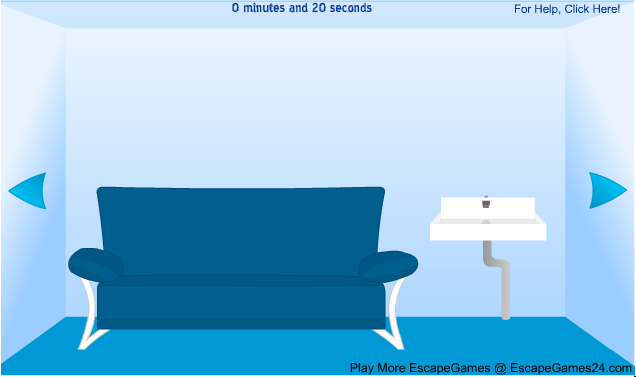
Trying to find something exciting to write about for this creative response, I found myself getting quite distracted exploring all manners of interactive stories and games. One puzzle game that I found particularly interesting considering our class is starting off with the idea of Platforms, was a game called “Escape from The Blue Room.” This game is one of many “Escape the Room” Games, apparently a genre in of itself, one of the most popular being “Crimson Room.” At its most basic, the goal of the game is to escape from a digitally rendered room that you inexplicably find yourself in upon the start of the game. By using the computer’s mouse (or track pad) the player clicks around the two dimensional room hoping to unveil clues through the narration that pops-up above the viewer or by finding “hidden” objects. One-by-one you gather objects and information, which you can then use (by clicking and dragging the item over another item on the screen) to find new clues, turn on items, open items, and other things. On the surface “Escape from the Blue Room” seems like just a first-person, point-and-click game, but I’d argue this is also an expressive work of new media that works to critique our culture’s views of literature and storytelling.

“Escape from the Blue Room” and most Escape the Room games rely on the assumption that the user is familiar with the structure of a story. These games have a narrator (a character), a narrative structure, plot devices, and even clichés unique to their genre. When you first start the game, you have no idea why or how you’ve come to be in this room (though this is not the case with all Escape the Room games), but simply by clicking on the screen once you can get a good idea of how to move forward through the game. The narration above the viewer will tell you simple things like “It’s a blue couch,” but it will also occasionally provide unique details like “It’s a water tap. But without a handle.” It is these pieces of narration that work with the various object you find (like the water tap’s handle) to transform them into plot devices. In this way, the game has a narrative structure, requiring you to complete certain tasks before others, such that the story unfolds fairly linearly as you get closer and closer to escaping the room (the ending). It is not necessary to complete gather all items in order, however. For instance, you can grab the aquarium net before filling the glass bowl with water to place the piranhas in, but you would not be able to advance the story (taking the piranhas out of the aquarium) without having both items.

Opening scene of “Escape from the Blue Room.”

Another obvious literary trait of “Escape from the Blue Room” is that there is a narrator, or a character. Obviously this is a first person story, with the user controlling the current view, but the narration itself has already been created and is not controlled by the user. This makes it seem less like the user is playing the character, than the user is simply unveiling the character’s words and thoughts through clicks. It would be like having a book with pages made out of scratch off ticket material and you have to go through it will a quarter scratching off narration to read the story. Analogies aside, though, just because the viewer happens to be my view, I do not necessarily feel like I as the user have agency in this story, but rather am simply attempting to piece together a story already in place.

In short, I definitely think that “Escape from the Blue Room” speaks to the idea that these game users must utilize and exploit their skills as readers to win the game. By having a familiarity with the devices used in literature (narrators, narrative structure, plot devices, etc.), and by treating the game as a piece of electronic literature to be read, unveiled, and mulled-over, the game becomes less about winning and more about finishing the story.