The Importance of Graphic Novels and Pretty Resumes

When I took Professor Tamara Harvey’s class for English 701, I had to read Scott McCloud’s Understanding Comics. It absolutely made me think differently about comics and the graphic novel, but I still wasn’t sold on their usefulness in the classroom.

What’s ironic about my dismissal of using graphic novels in the classroom is that I was a yearbook adviser. I went to countless workshops all over the country to learn how to get students to READ the yearbook and every workshop stressed using modular coverage (a “mod”). A mod can be a graph or a little side story with a photo or statistics or something like that– think pictures and infographics. The point is that it breaks up a story into bite-sized chunks to make the information more palatable. I knew that if I wanted students to read the yearbook, I’d be more successful in my pursuit by using mods.

Three years later this pin on Pinterest, combined with this week’s reading, finally sold me on why it’s perfectly acceptable to use a graphic novel in the classroom:

resume

The caption for this picture says, “This is what you’re competing with, people. If you don’t know how to make a pretty resume—outsource it to someone who does”. It made me realize that just as language changes, so does its presentation to people. I don’t care how old you are, sometimes “pretty” language, complete with pictures, is the most effective way to communicate something; this week’s readings are an example of this.

Joy explained it well in her post. Unlike Joy, I read (or re-read) McCloud’s chapters before reading the other articles. I thought it was almost hypocritical for the authors to laud the picture book or graphic novel and yet describe the importance of lines, for example, using words. McCloud’s work shows just how much work and thought goes into the creation of comics. Rather than only using words, the author uses pictures as well to communicate. That is talent.

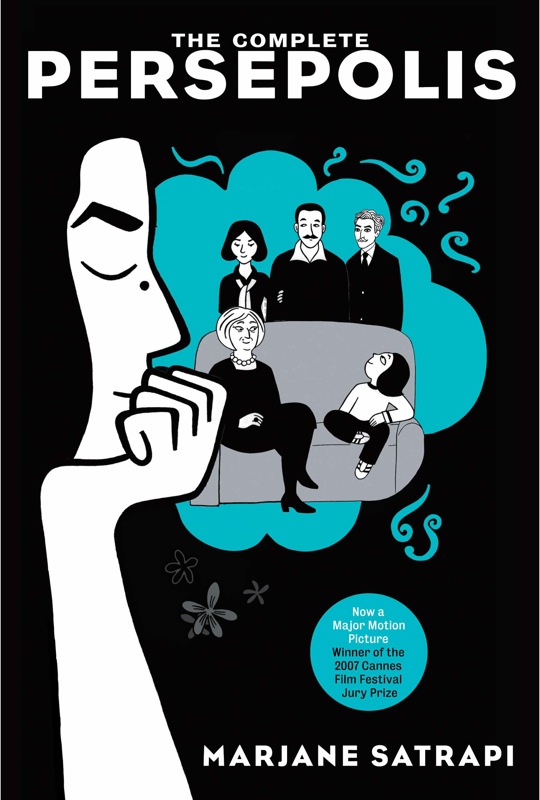
If you are like three-years-ago me, and you are still on the fence about using graphic novels in the classroom, consider reading Persepolis by Marjane Satrapi.
persepolis

I read it for Professor Harvey’s class and learned more about Islamic culture and the revolution than I’d ever learned before (and yet I still questioned the presence of graphic novels in the classroom!). I could have read a memoir on her, but it probably would’ve taken me a longer time to read it, and I wouldn’t still remember it, that’s for sure.

I guess what I’m trying to say is that comics, graphic novels, infographics, mods– it’s where we are going. Just pick up a newspaper! Think about how much more you learned from textbooks when they used pictures. Thinking back to one of our first readings from Lee Shulman’s article, “Taking Learning Seriously,” he said “If we take learning seriously, we must take responsibility for the ubiquity of amnesia. We need to reexamine much of what we teach, and how we teach it” (13). Graphic novels definitely deserve a place in the classroom because if this sleep deprived mom can remember comics and a graphic novel from three years ago, I’m pretty sure a teenager will as well.


Equal Mediums?

The readings this week were about graphic novels, comics, or any other sort of “picture book” and how they are more complex than one might first expect.  I strongly support using graphic novels in the classroom whenever possible—especially when students are choosing a book freely to read. They often seem less intimidating to students who are not strong readers, or seem like an “easy” choice to students who are good readers, but in reality they are complex and thought provoking.

Even knowing this, I was surprised by how much detail and deliberate choice is involved in constructing these works.  Kyle Baker’s preface highlights this, saying, “Comic books/graphic novels are a visual medium, so it’s most important for an artist to choose a subject with opportunities for compelling graphics” (6).  Not every story can be successfully told as a graphic novel—so from the very beginning, the author of such a novel must make a good choice.  Understanding Comics takes this idea of deliberate choices further in speaking about the gutter and how “in the limbo of the gutter, human imagination takes two separate images and transforms them into a single idea” (66).  Readers are much more active in this reading because they have to take what is left unsaid, undrawn, but that does happen, and fill in the gutter.  Thus, “to kill a man between panels is to condemn him to a thousand deaths” (69).

The details matter in graphic novels, and I would not deny that everything from color, to shape of the frame, position of the frame, to size of the frame and much more play a role in this.  I’m convinced—graphic novels require care, thought, and active skills in both creating and reading them.  So here’s my question—are they literature? I can’t deny that reading all 200 pages of Nat Turner had me emotionally invested, sickened, confused, uncertain, and sympathetic at different points—all things any good piece of writing should do.  But I also can’t deny that it only took me an hour to read, which would not be true of most 200 page works of literature.

So is time spent what makes something count as literature? Is it the ability to decode specific symbols? Or is it the story, the ability to get caught up in something outside the self, the absorption in another world, the puzzling through and coming to a conclusion in the end?  Aren’t all of those things part of what we value about literature? Don’t we get all of those things out of good traditional and good graphic novels?

The genres are still different—to say their not cheapens them because the form is part of the work whether it is a traditional novel, a graphic novel, or even an oral folk tale.  But maybe the point is that since each can be equally complex, requiring thought and interpretation, we should regard them as equal mediums of story.

Graphic novels through graphic teaching

Joy Wagener

I began this week’s reading with the Cohn, Rabkin, and Nodelman pieces, thinking they’d prepare me for what I would have to figure out in the more graphically presented material in the McCloud chapters.  I started with what was familiar, yet was completely thrown by the language they used and the material they discussed—it just didn’t connect as well because there were not always illustrations of what they were talking about.  How can you explain a graphic medium without including some graphics?  For example, Nodelman’s article goes into tremendous detail about the stylistic devices used in graphic literature. He discussed the format, mood, shapes, lines, symbols, point-of-view, focus, color, and movement in graphic novels, yet he includes few than 25% of illustrations of these styles.  The Cohn article (“Mis-en-Page”) offered more complicated information (theory?) about graphic novels which left me feeling more confused about what he was discussing; he included a few illustrations of what he was discussing, but I cannot say that I really understood his point about “conventional, rhetorical, decorative, and productive” conceptions.  I felt these articles were informative, and even interesting, but I had no idea what I was missing until I picked up the McCloud chapters.

McCloud described all of the stylistic devices of graphic novels that the other authors discussed, but instead of just telling about it, he actually showed it to the reader.  His delivery of information about graphic novels through the media of a graphic novel was highly effective and I found myself really enjoying the lesson.  I especially enjoyed his conversation about the “closure” leaps made between panels of a comic and the chart of those closures on page 74.  I referenced these closure methods throughout my live Tweet of “Nat Turner.”  I’ve read comics and graphic novels before, but I had never really thought about how much the reader invents the story between panels.  Then in chapter four, McCloud goes into more depth with the use of time made between panels, in the “gutters.” It’s very easy to follow along and understand the concepts used in graphic media.

Having completed the reading, I felt armed and prepared to take on “Nat Turner.” The pre-reading material made “Nat Turner” more enjoyable for me as I was able to identify the stylistic choices and techniques Baker used to tell the story, leaving out information and allowing the reader to fill in the blanks.  I’ve been tossing around the idea for a while now of teaching a graphic novel to my students, and now that I have these articles and information in hand, I feel well prepared to do so— but they’ll definitely have to read the McCloud book before reading the assigned graphic novel.

Reading or Comic-Reading? – Robb Garner

McCloud’s breakdown of the cognitive process involved in reading comics was quite illuminating.  I certainly agree with his use of the word “faith” in chapter three to describe the process by which we conceive of a single reality from our innumerable but fragmented observations and experiences.  Chapter 4 felt a little flat to me; the assumption that a photograph represents only a single moment in time doesn’t seem to be especially relevant.  I have no photographical skill myself—which is really a bummer—but I appreciate photography precisely because it is capable of presenting so much in what seems like so little (i.e. a single second); every photograph is a story In Medias Res and the best ones expand into both the past and future exponentially.  In chapter five, about the use of lines, this seems to be something left unsaid; while Chester Gould was able to help create his character Dick Tracy with bold lines and excessive shading (in the picture on p. 126 Dick Tracy explodes out of the netherworld of his blazer) these were also presented in tandem with Tracy’s dialogue and situation.  Moreover, Dick Tracy himself is found in a context of the hard-broiled American hero.  Dick Tracy, the comic, helped establish this genre, of course, but it also played off of previously established roles—most notably the cowboy myth.

Rabkin seemed like a good example of the strong apologist movement, defending the validity of comic books against their poor reputation in a way that doesn’t seem totally authentic to me.  For one, I don’t think that reputation actually exists in my generation.  For another, we might not read comics in schools, but that doesn’t mean it’s because we think they are below education.  It’s quite likely because comics are 1. New 2. Untraditional and 3. Not universally popular; many teachers don’t like comic books, so why would they go out of their way to teach them?  I’ve read one or two graphic novels, which I enjoyed to some extent, but I’ve never considered comics lowly or foolish.  I think one thing that might betray comics is that since we use the same inferential-interpretation method for reading them as we do constantly to make meaning (reality) in our lives the impetus is to read a comic quickly; it doesn’t take the time that reading a traditional narrative does, and because the comic is a series of images (a strip) we aren’t asked to patiently go through each image in the way that being at a museum asks us to look at each painting even though there are many.  As Cohn says, it’s easy to forget that a comic strip occurs on a page.

The readings this week have really got me thinking about the difference—if there is one—between interpreting words and interpreting pictures.  Comics blur the line that does, in some small but pragmatic way (the respective medium of presentation), exist between them, but they also ask us to ask the question, “Do we read comics?”  This question, in turn, makes us stop to think about our definition of reading.  I keep thinking about the cliché, “A picture speaks a thousand words.”  I wonder.  Like interpreting a poem, skilled interpreters engaged simultaneously in an interpretation will find a considerably larger amount of meaning / potential meaning than a single, isolated, and otherwise untrained interpreter.  This suggests that a picture speaks as many words as the interpreter is capable of reading into it.  Moreover, we’d all probably describe the same picture definitely, just like we’d draw the same description differently (though our artistic abilities would differ significantly).  Not only are the amount but the type of words will also be different.  The same, though, is true with interpreting a poem (as we have seen).  Is there any essential difference in the means of interpretation?  What if we did a comic strip for the Ball Turret Gunner poem?

I’m inclined to conclude—however hastily—that the distinction between interpreting pictures and literature is mute, and that because reading is, at least in my viewed, an act of interpreting words the term “reading” itself could be applied to interpreting comic books or picture books without much controversy.  Thinking about that, maybe Rabkin’s right and I am wrong: Maybe the reason we don’t spend time interpreting comic books is that while we’re capable of agreeing that graphic novels (for instance) are a legitimate form of art we’re still not going to approach them with the methods we have learned and practiced from and for tradition models.  For example, on p. 89 in Nat Turner we see young Nat reading the bible.  This is the first image of the bible we have in the novel, and the cross on the cover is upside down.  On the next few pages it is right-side up.  Now, is this original inversion because Nat Turner, trying to teach himself to read, probably first didn’t understand which way the letters / words were oriented?  Or is Kyle Baker indicating the cross on purpose to indicate that Nat Turner was destined from the beginning to be like Peter rather than Christ?  (In Catholicism, the Petrine cross is an inverted cross which represents Peter, the first Pope [who was given “the keys of the kingdom” by Christ], who was crucified upside down.)  I thought about the second possibility first, but I ruled it out almost immediately.  Why?  I suppose because I was reading a comic book and not a poem.  On the other hand, one of the problems we face with comic books could be that we non-comic book readers don’t know the tradition that comic book writers come out of.  When I read a published poem, I have an idea about what the poet has read and some conventions that will be used or ignored—these will help me interpret the poem.  With comic books I don’t know any of this.  Is the tradition employed that of comic books themselves (do comic books reference previous comic books the way literature references previous literature), or the traditions of photography, or literature, or all of them?  Can I really be asked to juggle all these different mediums and their traditions?  Taking comic books too lightly might be a problem, but the prospect of taking them seriously presents its own problems as well.

Did gig? Gig did. (A “Sonny’s Blues” Palindrome)

Inspired by Lisa Samuels and Jerome McGann’s work on deformance, Rob Pope’s work on textual intervention, and Nick Montfort’s palindromic version of Star Wars, one of the ENGH 610 students has written—with apologies to James Baldwin—a palindrome inspired by “Sonny’s Blue’s.” Here it is, courtesy of the student, Betsy Allen.

Did gig? Gig did.

GI day,
eh…lived on.
Mom, Dad, level.
Mini Son did gigs, solo.
Rats!
A party-trap.
A star! O, loss?
Gig did no sin.
I’m level, Dad, Mom.
No devil, he.
Ya dig?

Writers must also be readers

Joy Wagener

Several of the readings this week focused on the need for students to write—write more, write with ease, write through the difficulties, write to know oneself, write for others. As many of the authors reflected, writing is HARD.  Grading writing is HARD.  I think that’s why so many teachers shift their focus to literature, or have students use writing as a way to demonstrate mastery of the assigned literature. I know that I’m guilty of using writing as an assessment tool instead of a tool for learning. So, how do I transition from writing for assessment to writing for learning? How do I make room in my curriculum for writing without burdening myself with grading or without cheapening the writing process with rubrics, expectations, and guidelines?

Echoing Elbow in “The War Between Reading and Writing,” it’s apparent that many new English teachers are not well prepared in teaching writing, but are overly prepared to teach literature.  I know this is true of my background, coursework, and licensure. Writing is just supposed to come, right? I think part of the difficulty in instructing students to write comes from the teacher’s own level of comfort with it. For example, in “When Writing Teachers Teach Literature,” Cheryl Glenn keeps a diary throughout her semester to document her feelings about assigning writing to her students. She is at first uncomfortable with how much writing she plans to assign, doubting that the students will engage with it and doubting that she’ll be able to manage grading all of it. I can completely sympathize with that! Throughout her semester, the same students keep returning to her office hours to raise complaints or to conference with her about why they have poor grades. It’s an uncomfortable situation, yet she usually has a “big picture” response for them. She reflects that it’s difficult for her to dig her heals in and stick to the value of doing all of this writing, revising (or contrastingly, NOT allowing her students to revise) as it becomes more and more difficult. “Jill” hasn’t met the group work requirement while “Dan” has not listened to any of the feedback from professor or from his group. Glenn is conflicted over the pedagogy of what she’s doing—should she allow students to be truly independent in writing? Or does writing have to require a reader as well?

Elbow argues that all writing requires a reader. Readers are the ones who interpret and negotiate meaning in a text.  So even if the reader is oneself, or just one other person, or a much larger audience, one must write with an effort of clarity. In William Cole’s piece called “Less as More, the Ten-Minute writing Assignment,” he has a great activity for teaching students to write with clarity and concision. Dealing with an enormous class size, he gets students to write one to three sentences each class on a specific prompt. Not only do the students have to be concise and clear, but they have to demonstrate mastery over the content and grammar within the sentence constraints. The result is a clear idea of what the student knows—and it’s faster for Cole to assess. I love this idea! It’s a writing challenge reminiscent of Tweeting out messages to #ENGL610.

Writing is indeed a challenge, just as reading is a challenge. However, they both need to be taught, if only has a means to the other. Writing takes time. In the end of the semester, Glenn notes that the process—all of the doubts, conferences, confrontations, conversations, and growth—was worth it.

Whatever happened to Colonel Mustard in the Library?

Put me on the ‘now what?’ boat too.  Echoing Megan, okay, so there are 36 principles I’m willing into buy into — traveling across generational, cultural, and academic bridges—how do I make them work for my students?  Low and behold, the bright-minded among us, Liz, created a pretty remarkable three-identity translation.  I strongly applaud her work and agree with all three.  Taking inspiration, if I may, want pivot ever so slightly…

In regards to the projective identity, another idea might be how do the other characters perceive Jane?  Despite Gee distinctly pointing out the difference, “Remember that the projective identity is the interface identity between one’s real world-identities and the virtual identity. The projective identity is the space in which the learner can transcend the limitations both of the virtual identity and the learner’s own real-world identity”, what happens if a virtual identity isn’t even a century away?  What happens when you want to keep students present and cognizant of that world’s rules? (63)  To me, I’d turn to the next best comparison, public versus private identity and discussing how authenticity appears there.

Perhaps its just because I’m on Dowtown Abbey withdrawals or Liz has me in the classical Jane Eyre mindset, but I can’t help but delineate Gee’s concept to Lady Mary.   For the non-PBS enthusiasts, this particular character doesn’t have a strong history of kindness.  Then, she gets married and has all these warm, wonderful, private moments with her husband—one of which specifically acknowledges the public v. private fact: I’m glad you think I’m nice, even though no one else does.

The virtual-world, for all books we discuss pre-1990, was a steep social, class hierarchy—how characters are selectively viewed out in society (as compared to online). Complications escalate when reputations precede characters, characters are/are not privy to such facts, how this all informs their identity/action, etc. etc.—abundant classroom discussions ensue.

And, if I can rewind to his first identity to comment on the following: “Of course, the students are not ‘real’ scientists and are not going to become real scientists any time soon” (55).  Extrapolating this idea to my composition classroom, I take large, hefty disagreement.  It would seem, ‘students as scientists’ is as lightly applied and removed as one’s hat.  I want students to become real (without quotations!) lifelong readers and writers.

While I am trying not to base Gee’s learning theory on my own limited experience, its hard not to travel down that slippery slope; Tetris, Mario Tennis, Donkey Kong, Mario Super Kart, or Sean White’s snowboarding game did not provide me  “learning, and learning in deep ways” (215).  Comparatively, I’d venture to say Clue, Monopoly, and the obvious Game of Life, provided a much deeper learning experience—but then again [playing my own devil’s advocate] aren’t video games today’s Hasbro equivalent?

Quit gaming around – We have work to do – Goals & Realities of Learner Theory

Reading Gee’s book often had me thinking that some of his principles of learning were an act of re-inventing the wheel (saying something other disciplines have said in other ways before).  The more learners I engage with throughout my graduate studies or in my day job the more engrossed in learning theory I find myself.  At work my students vary from young administrative staff to older lawyers and corporate executives.  I teach my corporate students how to work with my company and maintain their intellectual property portfolios with respect to international IP law.  Therefore, I currently find it hard to relate to the sentiment that “Learning should be frustrating and life enhancing.”  Not only is the landscape of my “classroom” constantly changing, but the “affinity groups” and existing domain knowledge of my “students” is either unknown or unlike my own.  I suppose if I help a client understand the aforementioned business factors more readily they will have improved day-to-day practices both within their roles, but also in relationship with others sharing that domain content knowledge/experience.

Like many others, I have little experience with “gaming” and I consider myself a novice at best of very old games (but I can play a guitar decently and sing).  I also have my own opinions on some of the psychosocial drawbacks of gaming that are not mentioned in Gee’s book.  That being said, I’d love to have time to devote to practicing things that are entertaining as well as brain exercises that would lead to greater critical thinking skills.

No matter the type of learning being examined (Gaming, Academia, Corporate America/Earth), the concept of situated cognition is fundamental to any sort of individualized analysis in relation to the personal, material, social, and cultural world (9).   But without the psychological and emotional make-up of our learners we’re viciously lacking in variables, left to guess and check (probe-re-probe-re-think) ourselves.  At work, I called this the adaptive training service model.  Despite this, Gee’s taxonomy of learning principles is quite comprehensive even though his examples are drawn from only one domain and very few test subjects.  The multitudinous connections that are identified through such studies are difficult to generalize upon even when only looking to himself and his son as learners.  Even more essential to his points on critical and active learning is the fact that both he and his son are motivated learners who regularly actively reflect and strive for new meaning.  Their meta-cognition likely far surpasses half of the population that is considered below average.

Don’t get me wrong, I promise I am not always this cynical (maybe I just had a particularly futile day at work).  Perhaps, I am just skeptical and left with several doubts when trying to apply these principles outside of the domain of video games.  Learning Principle No. 6: The “Psychosocial Moratorium” Principle states that while the learner is learning the consequences are much lower than they would be in the real-world.  I would compare this to any simulated training environment such as N.A.S.A. space simulation or practice projects in the workplace.  Both are used to create a “safe” space for learning.  Additionally, Learning Principle No. 10: Amplification of Input Principle state that as a learner applies him/herself to learning their level of effort or time spent practicing (input) is exponentially rewarded with “outputs.”  I’m left wondering: Can a learner discern the outputs from within the realm of the psychosocial moratorium?  Is the learner being rewarded in their room with the padded walls?  In real-life, in a workplace, are the outputs of learning your job always tangible?  Of course not!  So, despite learning how to make learning fun from video games we are still left to confront reality.  I am willing to put reality aside in lieu of critical learning, even if the only output is annihilating your previous “regime of competence.”  It seems to me what we have to impress upon our students is not learning in the guise of a game/design space, but learning in a goal space.  Whether or not a person is goal-driven may be because of their nurture (i.e. how they were brought up/their experience), but I’d hope that it is open for revision.  Gee would likely hone in deeper to discuss the differences therein of process oriented individuals vs. reflective learners.  Considering only about half of our population is goal driven and an even smaller percentage actively reflects and reassesses those goals, the task at hand is lofty. Needless to say… I am left wondering.

Heroes of Might and Magic, boys, and lesson pacing

I’ve only played one computer game: Heroes of Might and Magic.  To build my army and buy the castle I wanted, I needed large amounts of minerals.  I remember most of the game I would hit refresh over and over again so that I could replenish my ore and sulfur mines.  Most of the people I know (including my students) who regularly play video games are men and boys.  I don’t have a hypothesis for why this is the case.

I’m curious though, about how Gee’s work on video games and learning might relate to boys’ academic performance and engagement. There is a lot of talk in education right now about girls surpassing boys (in K-12 at least). I wonder how this fits into the conversation, or could be applied to what’s been deemed by many as a big problem.

My experience with video games is limited, but Gee’s explanation of “active learning” and “critical learning” in semiotic domains gave me a new perspective on what and how I’ve learned as I get older and my scope of experience gets a little wider.

Gee’s descriptions convinced me that some video games could make literary concepts more visible for students.  I can understand how it would be easier to see the conventions of various video game genres than the conventions of a film or a novel.  If you have to participate in a first person shooter game, for example, it’s hard to miss that your character is just part of your arm.  Asking a student to explain the possible effects of first person perspective in a novel is trickier.

Gee’s “Explicit Information On-Demand and Just-in-Time Principle” made me think about how important pacing is in a lesson.  One of the more difficult parts of lesson planning is figuring out when and how to present new information, and how much new material to present at one time.  I liked Gee’s succinct take on this balancing act in his chapter on telling and doing.

The summer of Tomb Raider

I approached the James Paul Gee text with curiosity and skepticism, given my own experience with video games. I have to admit that my last true dedication to a video game was when I “wasted” a whole summer playing Tomb Raider with my sister on our PlayStation. At the end of our video game experience I can remember feeling an odd sense of accomplishment (having successfully battled oversized rats, and winged zombie-like-monsters as I remember them) but I don’t recall feeling like I benefited from some insightful learning experience. In fact, when I reminisce about that summer it has always been with a small sense of embarrassment. When I think about all the other productive things I could have done during that time, there is a small shame. I enjoy a game of Super Mario Bros every now and then on my Nintendo DX during a long ride (and even finished my last game, yea me!) but in general I really don’t devote much time to video games. Reading the Gee text forced me to look back on that “wasted” summer and rethink my whole experience.

The version of Tomb Raider that I played was different from the one Gee describes in his book, but I found myself wondering if there were things that I was learning, even unconsciously, as I played the game. Gee writes that playing certain video games like Lara Croft can give players the experience of “trying new identities that challenge some of their assumptions about themselves and the world” (117). He also explains that taking on another character can make you, at least while you are playing the game, become more like them than yourself. I can see how taking on different perspectives can make you a better learner, but I don’t remember having such an experience when playing video games. In fact, when I played Tomb Raider many years ago I never felt like I was becoming more like the character while playing. My goal was to conquer the game by any means necessary because I was interested in how the story would unfold; I don’t think the experience challenged any of my views about my surroundings or myself. I also must admit that as a female playing video games I am often concerned and agitated with how women are portrayed. I think this concern has kept me from fully identifying with the characters that I have previously played.

Overall, there is value in engaging in a conversation about video games and learning. Playing video games can definitely be challenging, and Gee correctly points out in the beginning of his text “confronting a new form of learning and thinking can be both frustrating and life enhancing” (7). We have discussed previously in this course how working through frustration can deepen our understanding of things, and does add value to the learning experience. The particular game that I am most familiar with may not have opened my eyes to new knowledge, but I do believe that there are video games out there that can certainly accomplish that task.  For this reason I do see the merits in Gee’s argument.