Searchers– The Pervasiveness of Batman (Nathalie)

In Tuesday’s class, Professor Sample mentioned that The Dark Knight Returns wouldn’t have even been possible if there hadn’t been a few changes in the industry. These changes included the creation of a writer/artist celebrity system, writers gaining more control over their work and writers receiving royalties and shared rights. With more rights and freedoms, writers grew more creative. Recently, however, I think there has been another change that has changed the world of comics again– the advent and consequent invasion of the internet. The internet has started a new brand of comics altogether: Web comics.

I noticed that Batman is so pervasive that he has even entered this realm. The most interesting web comic I stumbled upon was this: Batman and Sons.

Like Miller, this portrays Batman as being older and yet…it is absolutely nothing like Miller. “Batman and Sons” is a nod at Grant Morrison’s graphic novel, Batman and Son, which also features a “gritty” Batman. Yet in this web comic, even though Batman has to deal with dirty diapers and hyperactive children, his character is no less curmudgeonly (well, most of the time). The comic itself may not be dark, but it doesn’t go back to being campy; it definitely continues in the tradition of Miller’s angry, grim Batman.

Something like this couldn’t be sold in stores without incurring a whole lot of lawsuits. It’s similar to the comics that newsstands wouldn’t sell if they weren’t approved by CCA. While the internet was a societal change (as opposed to a change the comics industry instigated), it still provoked creativity among artists and writers. But then we get into the idea that anybody with any opinion can say or draw anything on the internet even if the rest of the world doesn’t care about said opinion– but that’s a story for another time.

Other web comics that incorporate Batman:

http://www.qwantz.com/index.php?comic=1543
http://www.whiteninjacomics.com/comics/batman.shtml

http://www.whiteninjacomics.com/comics/batfriend.shtml

Searchers, The Question of Fascist Undertones in Miller, Batman

http://snipurl.com/rptb1

The above link is a blog post by one author concerning alleged fascist undertones in the work of Frank Miller with some substantial back and forth in the comments.  The presence of fascist attitudes has been a popular accusation with regards to Miller, Batman, and superhero comics in general. For this reason, I think it is valuable to examine the post and comments as a typical discussion of this issue. It is, in my opinion, safe to say that Miller’s work occasionally incorporates fascist ideals (300 being the big example).  (I am definitely not saying that Miller himself is fascist / loves fascism and fascists / wants everyone to be fascist or that his work is one big hurrah for fascism.)  Ultimately, however, the post and comments shed a certain amount of light on the underlying politics and themes of Frank Miller’s work, and reader reception to those perceived politics, if not to the actual politics of Miller himself.

(I also do not vouch for how competent or articulate the blogger and commenters are… some points are poorly argued, or operate within a definition of fascism that is excessively broad.)

“Project Girl Wonder” Robin in “The Dark Knight Returns”- Searchers

http://henryjenkins.org/2009/06/an_interview_with_mary_borsell.html

This link is to an interview with Mary Borsellino who authored Boy and Girl Wonders: Robin in Cultural Context. The interview explores the conception of Robin, who has been played by a girl twice in the Batman series, the first time by Stephanie Brown, who even sewed her own red skirt to match her costume.  The first time Robin was played by a “Girl Wonder” the idea was “handled clumsily with obvious institutional sexism” (Borsellino). Stephanie Brown was controversially tortured with a drill, killed and promptly forgotten by Batman. Borsellino makes some interesting points about the concept of the “Side-Kick”….often the side-kick represents a group already marginalized by society, whether it’s through gender, race, or physical ability.  Robin, played by Carrie Kelley in The Dark Knight Returns becomes a “transgender” figure, as she is even more androgynous in costume than civilian life, she’s even referred to as a “boy” on the news.  Stephanie Brown’s Robin was quite androgynous as well, before becoming Robin she was “Spoiler” who even fooled her own father into believing she was a boy. However, Borsellino seems hyper-sensitive to the gritty and realistic dialogue in The Dark Knight Returns; I think the salty language matches Miller’s vision of Gotham City and it’s inhabitants.  Her feminist criticism The Dark Knight Returns can only accomplish so much, although her theories about Robin are worth taking a look at.

Searchers — Frank Miller interview about The Dark Knight

We were talking in class today about  Frank Miller’s inherent cynicism/bitterness after the whole debacle with DC. This brief interview is, well, uber brief. Miller has about two quotes, and the MTV correspondent spends more time dwelling upon the flop of The Spirit rather than the genius that is The Dark Knight Returns.  Nonetheless, the snippet is about the latest Batman flick, The Dark Knight and what Miller thought about it. And yes, it should have been called The Joker. But perhaps Heath Ledger’s death contributed to a lot of hype before the movie’s release. I would love to see a film version of The Dark Knight Returns under these stipulations: 1.) No Christian Bale. 2.) Frank Miller has a heavy hand in it. 3.) Elijah Wood is nowhere to be found.

Anyways, take a gander at the article here: http://splashpage.mtv.com/2009/01/16/frank-miller-on-the-dark-knight-they-should-have-called-it-the-joker/

Searcher, DKR/Understanding Comics–Shannon P.

I found an interesting link so I decided I might as well post it: http://bit.ly/zJYrk

This link should lead to an interesting article I came across; if the link fails, searching for “Dark Knight Returns” on JSTOR or Google Scholar should take you to it. The article is called “Splash Panel Adventures!” by W. Robert Johnson, published in 1989. I chose it because it relates to a lot of what we’ve discussed in class; the first half analyzes certain comic books based on criteria that are specific to the medium, like how panels are shaped and how the words relate to the pictures. The second half offers a short history of major and underground comic book companies. I think it the author’s tone is interesting given the year it was published. I feel like he still needs to defend the study of comics itself, giving them a criteria for analysis and a history. The second paragraph on the third page basically declares, “it’s not just adolescent boys reading/writing/publishing these things, really!”

Page 43 and 44 (don’t worry, it doesn’t start on page one) are especially interesting because he uses cinematic terms to describe The Dark Knight Returns, but goes on to describe panels and coloring specifically. His comparison of one scene to a “flip book” is, I think, the same concept that McCloud calls “Moment-to-Moment” and “Action-to-Action” progressions (McCloud, pg. 70). Of course, as the title suggests, Johnson focuses on the uses and importance of splash panels: individual pictures that take up most or all of the page.

A few more notes: if you want to see an actual comic by Scott McCloud, Johnson includes some panels from Zot on page 48. And if you haven’t read Watchmen yet, for goodness sake don’t read page 51, left column. He gives away the entire twist for no real reason.

Batman as Fascist?

http://plover.net/~bonds/comics.html#batman

Sorry for the delay in getting this posted up, but I hope the article is worth it.  I figured since we have a class with many a fan in attendence, a piece that challenges DKR’s place as a seminal work would be the best way to go.  Bond makes the case that Miller’s portrayal of society, crime, and art are all equally skewed by a fervently fascistic bent.  This is a pretty common question about comics from the eighties and ninties; as the works go “darker and edgier”, the shadow of Nazis and other horrifying groups are always raised, and often with good reason.  Is Batman portrayed as a fascist in a positive light by Miller?  Probably.  We just have to figure out what that means for ourselves as readers.

First Readers, The Dark Knight Returns- Ryan Anderson

My first reaction from reading the first two books of The Dark Knight Returns is how it really humanizes the Batman persona. This isn’t your fathers squash-buckling Adam West television program and it sure as hell isn’t a terrible Joel Schumacher film. This is brutality at Gotham’s finest; gritty, raw, and wait a second- blood? Frank Miller holds nothing back here, doing well to humanize the concept of the superhero, as well as the world in which that hero occupies. It’s not often we get to see a hero in the twilight of his career, old and graying, and at times, getting his ass kicked. Whether or not you’ve followed the caped crusader through his many debauchery filled outings over the years, this is a depiction mostly unknown to the general public. The old and bitter man, tortured from his turbulent past, still fighting with his inner demons and pissing at the idea of retirement- they’re all such a fascinating elements to incorporate into a comic book (sorry, graphic novel). As the reader we’re made aware of his aching bones, his grizzled and throaty voice; we’re made conscious that believe it or not, the mighty Batman has somewhat lost a step. Take the end of book 2 for example, in which he fights the mutant leader. First of all the dark coloring here is great. The lack of brights really emphasize the grime and violence of the scene has to offer and shows the brutality of what I think is the defining moment for this particular book. But what’s more important here is that we see a Batman who gets bruised and broken, who isn’t easily disposing criminals as he used to. He almost dies in this confrontation, had it not been for the 3rd coming of Robin (or 3rd or 4th?). In a city that nearly implodes without his presence though, Batman soldiers on, risking life and limb for the sake of a little thing called justice. Everything down to Bruce’s inner dialogue, to the transition between gutters, shows the collective effort to portray Batman as the battle tested veteran. This is something Frank Miller and Company do a damn good job doing. They show us a Batman who is human, who struggles with those he has lost and who questions his role in modern society.

First Readers, The Dark Knight Returns- Alexa Romano

The Dark Knight Returns is the first Batman graphic novel I’ve read. Not surprisingly, I am familiar with the plot (past and present) and the characters because of Batman’s presence in pop culture. Initially, I was overwhelmed. The narration of the plot changes constantly. The only graphic novel I was familiar with before was Persepolis which is told from one point of view. Miller constantly switches between Batman’s thoughts and his conversations with the Mutants/other villains, we read Robin (Carrie Kelly)’s thoughts, and the Police Commissioners. That’s not all! Miller’s use of the media and interviews add an outside point of view to the plot. These few frames add an additional third person narrative. We hear the debate surrounding the action of the plot.  

Many of the pages consist of frames with television broadcasters with the text looming over the picture of the news anchor. These aren’t your “typical comic frame” because there is no gutter between each frame. However, the picture of the anchor makes it seem like we (the reader) are watching the news. This relates to McCloud’s discussion of the comic book experience and abstraction. While he discussed it by saying that pictures in comics are more abstract so the reader sees themselves in the story, I see it (in terms of The Dark Knight Returns) that the television frames are being used to make the reader feel as though they’re watching the news. They’re experiencing these views of Batman in the comfort of their own home allowing the reader to form their own point of view of Batman.

Another good example of abstraction occurs on page 67. I was really into the story by the time I got to these series of completely black frames. I was on edge and I was so nervous and excited to find out what happens next. The dialogue boxes were my only clues until Miller revealed to me the location of Batman and one of the mutants. What I was imagining was completely different. Each frame their location changed but the suspense kept me reading. I’m amazed with my imagination after doing this reading.

First Reading – The Dark Knight Returns – Nathan Wallingford (Group 1)

The Multiple Personality Theme in The Dark Knight Returns

To be completely honest, I am really not that familiar with the world of comic books / graphic novels, so the nuances of the art and design of Frank Miller’s The Dark Knight Returns are essentially over my head at this point. What I can comment on, however, is the story of The Dark Knight Returns. And by far the most compelling part of the story for me was the multiple personality theme.
Bruce Wayne and Batman are far more than merely the tried and true template of the mild-mannered everyman and his superhero alter-ego. For Bruce, Batman is another character in and of himself, with his own thoughts and desires and even what seems to be a distinct personality. Bruce and Batman share the same body, but they don’t seem to really be the same person. For instance, beginning on page 13 when Bruce is mugged and relives his tragic origin story, Miller uses gray text-boxes to set aside an internal monologue that the reader can easily recognize as the thoughts of Batman, not the thoughts of Bruce Wayne.
Later on pages 25 and 26, as the temptation to return to crime-fighting has become too powerful, the internal voice returns, although now it isn’t merely a monologue but a conversation. The voice says, “ . . . I am your soul. You cannot escape me . . . You tried to drown me out . . . But your voice is weak . . .” Who is the “I” and who is the “you” in this conversation? The “I” is Batman, speaking to Bruce Wayne. Two minds inhabiting the same body. That seems like a cut and dry case of multiple personalities. And, of course, Bruce Wayne / Batman’s case of multiple personality disorder is made all the more interesting because his primary foe, at least in the first part of the novel, is Harvey Dent / Two Face. Batman and Two Face are essentially mirror images of each other. Each man has one foot in real life, existing as a normal person, while the other foot lies in Gotham’s criminal underworld where each man exists as some sort of spirit or caricature. Both Harvey and Bruce possess other selves obsessed with crime. It’s just that Two Face is obsessed with committing it and Batman is obsessed with stopping it.
The multiple personality theme is just one reason why The Dark Knight Returns is so much more compelling than the average comic book of previous eras. The primary conflict is essentially psychological. Miller does an excellent job of detailing Batman’s primary motivation, which is his deep-seated, irrepressible need to fight evil, for lack of a better term. Such a need rarely expresses itself in a neat and tidy way, and instead often leads Batman to engage in acts of violence that are barely distinguishable from those of his enemies. Perhaps this is why Bruce Wayne / Batman possess multiple personalities in the first place, as it is too difficult to remain a part of both worlds and act as the same person. Either way, the theme gives The Dark Knight Returns a depth and appeal that the average person would not expect from a Batman comic book.

First Readers, The Dark Knight Returns – Nicole Ocran (Group 1)

Scott McCloud’s idea that comics are a medium in which the audience is a willing and conscious collaborator is a compelling one. I love the idea of a participatory audience and taking the fact that we are not static readers into account. In Batman: The Dark Knight Returns, the audience is quite literally that, as we are dropped right into our couches watching a Gotham news telecast. I was pretty annoyed every time I had to read (or watch?) the newscasters or the debates on Point vs. Point, mainly because the questioning of the validity of Batman continues to live on through the media, but I thought that it was a great example of the closure McCloud talks about in our reading. A great example of this that comes to mind is the black frames on page 67, where Batman and one of the Mutant gang members are talking. The simplicity of the gray and purple speech bubbles leaves a lot to the imagination–where are they? What does the Mutant look like? And then as Batman takes his hands off the Mutant’s eyes, we are immediately placed in his (the Mutant’s) shoes, about to fall off of Gotham Towers. The ease in which the reader is able to become any character in the comic is a spectacular feat. Reading other literary texts doesn’t allow for much of that–I can see myself in the shoes of Holden Caulfield or Mrs. Dalloway, but here I am Batman looking into the eyes of my new Robin.

First Readers, The Dark Knight Returns- Jeannie Hilleary

In the year Batman: the Dark Knight Returns other great works were written like the Watchman, but what took the Watchman 12 chapters to accomplish too the dark knight only four. Throughout the beginning of book one (especially pages like 12 and 13) we see both Gordon and Bruce as old men on the verge of retiring. I see Frank Miller trying to use these dull shades to symbolize the characters feeling toward the end of their time. However, when batman returns and he says he is “reborn” on p. 35 we see Miller’s pages explode with color, and to me this is meant to represent the life that has returned to Bruce. As the comic moves into book and book 3 and the new Robin comes into play the colors grow even brighter as Batman’s family comes together to create the life he lived for. The new Robin is a reminder to Bruce of Dick and of the relationships that help to create him and keep him strong. A younger batman would have demanded to work alone and would have told her to go home but this Veteran, the lonely old man, knew he needed the help and the youth to help him stay young. This book makes me wonder if Bruce will ever die or if no death will ever be good enough for him. We see him almost die in a car accident and later on page 51 we see him with the chance for a “fine death” but discussing all the things he has left to do.
The addition of a female Robin made me happy because it brought a new level to the side kick. For those of you who haven’t read about the last Robins death or about the paralyzation of Batgirl I recommend reading the Killing Joke, also featuring my favorite villain of the Joker. The Joker leads me to the point the the Dark Knight helps bring to light the most for me which is Batman and his Villains can not exists without each other. The arguments that are constantly occurring by the psychiatrists can be seen clearly, Batman creates his enemies and then using them to prove he is alive and capable. We can clearly see in the Dark Knight Returns that the Joker, not having seen the bat in 10 years, would have remained comatose and harmless without his arch enemy their to stir things up. The Joker needs the bat and the Bat cannot feel alive without his villains like the Joker. It is arguable that without the batman the worst of the worst would not exsist. It is also clearly seen that without the Batman no one in the city would see that they can help change things, that they are the ones with the power. We can see how he is a symbol to the people and he encourages them to do what needs to be done. On page 90 we see the positive side of the Batman where he empowers the everyday people to act and to not live in fear. Without this action Bruce has set forth through Gotham many of the cities person may act more like the man on page 110 who lives in so much he would kill an innocent man.
When it comes to the style Frank Miller uses for the comic he makes sure that Batman, the Commissioner, and other prime characters are drawn in great detail and that the everyday people are drawn with less detail so that we can all relate to them. Miller often demonstrates the passage of time through the internal monologue of Bruce. Page 86-88 we get the feeling of time passing as he talks about hearing the bat as he convinces himself not to die. As he lays unconscious we can watch the world around him continue and even see as Robin roams the bat cave. Batman, in this comic, is constantly reminding us that he is not a super hero like superman but that he is a man with a goal and a purpose. We see him bleed and bruise and love and loose. He is not invincible and through scenes where his bones creak and he pushes his old body to the breaking point we relate to the man on the inside and what it is he is trying to bring to the city.

The Joker being my favorite villian of all time led me to find this link http://stars.ign.com/articles/841/841564p1.html if anyone is interested in seeing the evolution.  Its amazing how he used to be portrayed vs. how we have come to know him through media

First Reader-The Dark Knight Returns, Ben Fleser (Group 1)

Personally, what I’ve found so far to be most intriguing about Batman: The Dark Knight Returns is the fact that Bruce Wayne is now an old man, subjected to the obstacles and barriers of old age; stiff joints, a little more winded, etc. However, the art in the comic might suggest that Batman is going about his usual business untouched by the pangs of old age, as he seems just as agile and swift as usual. This is where dialogue is contrasted nicely with art, as it gives the reader the notion of a character’s physical ailments when it’s harder to be represented through art. An example is on page 49 where we see Batman climbing up one of Gotham’s towers, “Pain that’s three days old crawls across my back. I kick the dust from my joints and climb. It used to be easier” (Miller, 49). I imagine that Miller had to be very conscious of the fact that he is trying to present Bruce Wayne/Batman in his elder years, so the dialogue as well as the art must reflect this so that readers have a good idea of the concept. Forgive me for my Batman history arrogance, but was The Dark Knight Returns the first comic about Batman where he’s portrayed as an old man? Because I know this idea was used later in things such as Batman Beyond, the cartoon. If so, I appreciate Miller’s adaptation of Batman because it seems a little more realistic for me, if only slightly. People don’t stay young and agile forever, so presenting notions of the passage of time, aging, and eventual death, subjects super heroes and other comic book characters to the same things normal humans are subjected to. At least I think this is what Miller wanted to get at, after reading his introduction. We see Commissioner Gordon wrestling with this reality on page 58 when he says, “A young boy dashes past me, healthy, dirty, and beautiful. You don’t want to know what he makes me think of.” And later, “Dying never seemed real to me when I was young” (Miller, 58).  For me, these realities make the characters’ struggle that much more complex, as they fight not only against evil, but against themselves (See page 55). Overall, I think the notion of time is important concept to bring up when dealing with comics, as we will see this idea explored immensely in Watchmen.

Finally, (and I swear I’m done talking after this), I like the great debate that is being brought up over Batman in The Dark Knight Returns, as psychologists in the story keep trying to deconstruct him on sociological and psychological terms. I appreciate the debate being raised as it tries not to allow us to side immediately with Batman despite our strong inclinations. However, given the scenario of the story thus far, it might be pretty easy to side with him. But I don’t know, it’s up to you, and I haven’t finished yet so don’t give anything away for me. Just a few questions, does Batman shoot that guy on pages 64 and 65? I assume that’s what happened but I just needed some clarification. And how the hell did Bruce Wayne lose his mustache? I was confused at that.

First Readers, The Dark Knight Returns – Colin Kitler

My experiences and knowledge of Batman extends only to the media produced for a wider audience, and I am shocked at how much inspiration may have come from this comic book. Since this book predates any of the Batman films (with exception to 1966’s “Batman” starring Adam West) it is safe to say that the darker tone of most of the films can be attributed to Miller’s take on Batman. In “Batman Begins,” the same explanation of why bats were chosen as Bruce Wayne’s alter-ego is used (pg 18-19). The dark tone can be seen as far as the most recent Batman video game. The line on page 39, “The last ones usually lose it. So I let him. And let him come to me,” can be used to describe how most of the enemies are programmed in the game. If the last enemy in the room realizes that he is trapped alone, with Batman nowhere to be seen he will become terrified and start shooting at anything that startles him, such as a radiator in the room. But the most direct adaptation of Miller’s version of Batman can be seen in an episode of the 90’s animated series (episode “Legends of the Dark Knight”), in which some kids talk about how they think Batman is, including a direct remake of events in the comic which have direct quotes, shots taken straight from the panels, and even the fight choreography from Batman’s first fight with the mutant leader (pg. 72-81).

The episode can be found in two parts on YouTube, starting here, http://www.youtube.com/watch?v=26ZVuMsRx3c. You can skip to part 2 (http://www.youtube.com/watch?v=i-eZdMN4Udo) if you want to go straight to homage to this comic book.

Welcome to ENGL 493: The Graphic Novel

ENGL 493 is a class offered by the Department of English at George Mason University dedicated to the critical study of graphic narrative, more popularly known as graphic novels. And what you are reading now is the first entry on the class blog for ENGL 493. If you are a student in ENGL 493, you can register for the blog, something you’ll need to do before the first week of classes is over.

Even if you don’t want to register yet, you can still browse this site, which will play an essential role in our course this semester. Of particular interest to students in ENGL 493 will be the course guidelines and the day-to-day class calendar.

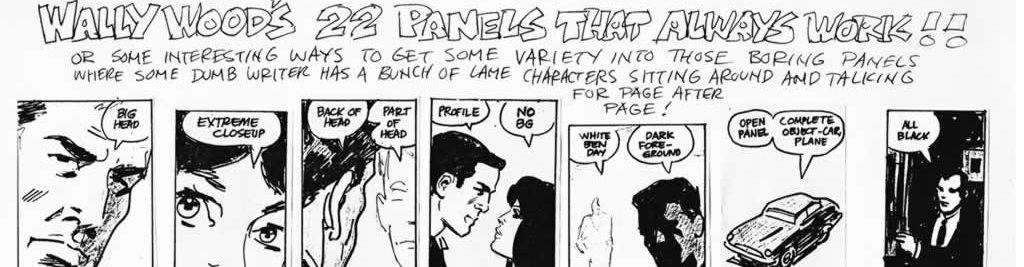
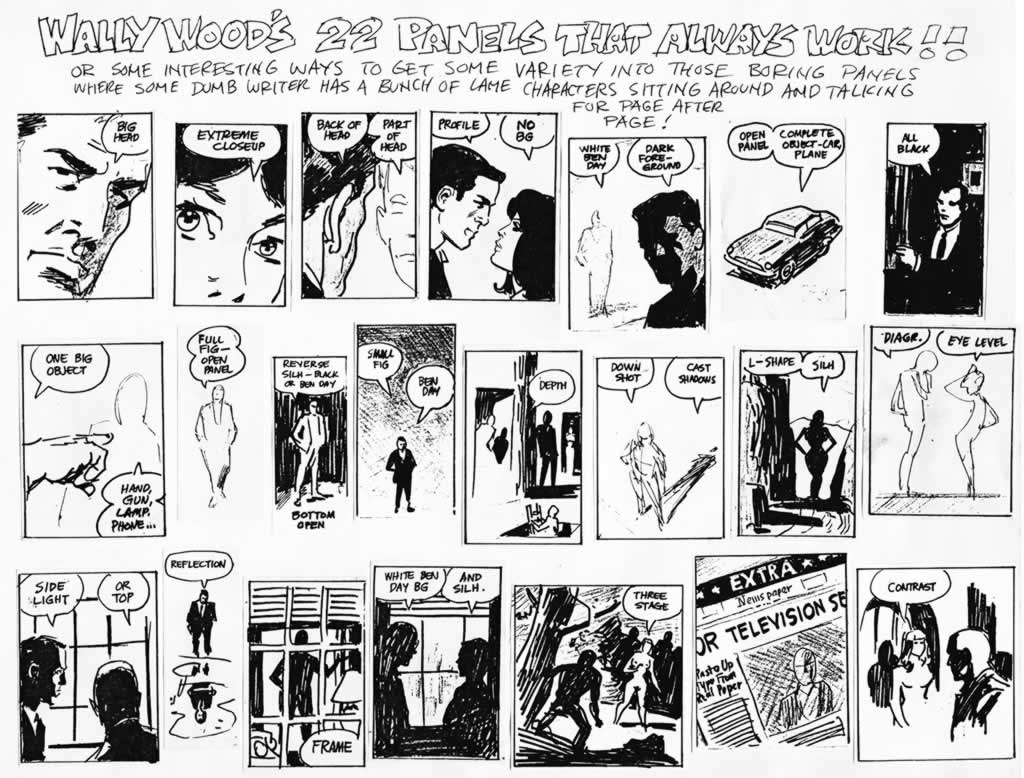
And finally, a note about the header image of this blog, a detail from the much larger “Wally Wood’s 22 Panels That Always Work,” a legendary document in the comics business from the even more legendary artist and editor Wally Wood. In 2009, Joel Johnson, the former executive editor of Wired, placed a winning bid on the original 22 panels, scanned them and placed them online to share with the larger world. Here are the 22 panels in their entirety (larger image):

Wally Wood's 22 Panels That Always WorkThese 22 panels appear to distill the artistry of graphic narrative down to an easily applicable formula that even a “dumb writer” can learn. But in fact, as we will see in this class, the emotional and intellectual impact of comics is not simply the result of using a “down-shot” with “cast shadows.” Much more is at work in every panel on every page, and I’m looking forward to exploring this complex art and narrative form this semester.