I really enjoyed the way that the second book of Maus started with a depiction of Art sitting at his table and unable to draw. I think it was an interesting insight on how writing this story is effecting the artist both personally and commercially. You can sense how much guilt and pressure Art is feeling about telling this story visually by seeing his character shrinking panel by panel into a minuscule man. It is a heavy task to maneuver all of the business aspects of his work in a way that is respectful to his and his father’s story. I feel that part of the reason why Art is incorporating more and more of his life and perspective on his father is partially due to the fact that he wants a well rounded impression of his father and how his father interpreted his time during the Holocaust. I feel that this book is just as much a father son story as it is a memoir of a Holocaust survivor. I personally enjoy the metaphysical touch of this book as much as I enjoyed the oral tradition vibe of the first book. It adds variety to the narration and shows a transition from just a father’s story with interjections from his son, to a son’s story about his life with his father and how they live with his father’s ghosts.
The Animals of Maus
I apologize for being “unoriginal,” but what I found most interesting this week were the discussions on the symbolic portrayal of characters as various animals.
I think that by portraying the racial and cultural divides more clearly, Spiegelman was able to further show how absurd it is to discriminate based on those factors alone. To me, it seemed almost natural for different species of animals to be biased against each other, but despite the fact that all characters were portrayed as anthropomorphic animals, it was stated more than once that everyone was human.
In various ways, it seemed that turning the humans into the animals they “became” was an attempt to make the horrors of the Holocaust make some degree of sense, and I found myself sometimes substituting the animals for the actual humans of the Holocaust in my mind when pondering about it.
It took a moment for me to fully register the fact that the tall, vest-wearing, cigarette-smoking mouse that Spiegelman portrayed himself as was the same person as the gaunt, depressed-looking, mustached man in Prisoner on the Hell Planet.
Weekly Roundup on Maus I (March 1-3)
If you’re in group 3, you’re responsible for this week’s weekly roundup. Each student in the group will highlight one key moment from the previous week’s online and in-class discussions. To recall the syllabus:
Follow this formula for the highlights: describe the moment (provide the context and the facts about what you saw, read, or heard), interpret the meaning of the moment (what does it mean?), and evaluate its significance (in other words, why was the moment important?).
You can post your highlight in the comments below (or in a separate post).
Week In Maus
This week we covered the use of animals as “masks”, and as division between nationality vs race. What the aesthetic, cultural, and narrative affects that are the result of the anthropomorphic nature of the text. We observed some of Art Spiegelman’s earlier work and how that shaped Maus, even becoming incoporated into Maus via Prisoner on the Hell Planet. We covered the various times we all came into contact with the work (I myself had been familiar with its existance since ever, but regretfully never got around to reading it until this class) and what that means of our readings today. We even got Inglorius Bastards, Daft Punk, and An American Tail into the discusion.
So what did I most take away from this week? The utter humanity of the piece, the dynamic artistry applied in its construction, and the surprisingly large amount of metanarrative.
From what I had heard about before of Maus it was a Pulitzer Prize winning graphic novel/comic book about mice as jews during the holocaust. Not much else. I kept hearing about how it legitimized the medium (often from non-comic afficianados). How it was innovative in its use of the mechanics of the comic strip (often from comic afficianados). And how it, along with Schindler’s List, was essential literature to understand the blight on human history that was the Holocaust. I didn’t appreciate how sorrowful and humanizing it actually was. When I picked it up to read Maus Book 1 I read the entire thing in one sitting. And then the next day I re-read it all again, in one sitting. I would agree with the sentiments about its mechanical complexity as well. Through the use of limited details and cramped illustrations we get the simultanous sense of isolation of humanity, and the crowding of people. We also have several visual motifs to guide us, the white circle as covered in class, the use of swastika like images throughout, the juxtaposition of modern and past scenes.
But again, what no one mentioned was how meta it was, I nearly always heard it described as a story of the holocaust, not of the story of the child of a survivor of the holocaust. That immedialty took my by surprise. And the story amongst Vladeck, Mala, and Art himself was a real driving force to keep reading for myself. It was also amusing how he mentioned maus essentially within it’s own pages.
And that’s the week in review, and my reactions to the work covered.
Putting across a story.
http://sunsite.utk.edu/witness/artists/spiegelman/
This article explains a little of the history behind the making of Maus. It tells why he wanted to write it and goes a little into why he wrote it the way he wrote it. What I found interesting was how it mentions that many Holocaust survivors found Maus to be a terrible representation of the Holocaust. The way the Jews were compared to mice and Nazis to cats seemed a lot like the Nazi propoganda movie we watched in class “The Eternal Jew” (“Der Ewige Jude”).
– Maus –
Reading through what people have posted on the blog, it is interesting to me how many of us knew of Maus or had read it before taking this class. Some people knew it from high school, others from previous college courses. I was required to read Maus in my Western Civilizations class. It kind of reminded me of Kyle Baker and how much he wanted Nat Turner to be used as an academic resource. It makes me wonder if Art Spiegelman had similar intentions when writing Maus, or if that thought came after its publication.
I would also like to comment on what seems to be the most popular topic, Spiegelman’s use of animals in the story. The first time I read Maus for my Western Civ class I read though and really appreciated the separation of race into something so simple as animals. I think it would have been much more difficult to show the differences between the Jews or Poles or Nazis if they all looks like normal human beings. That being said, I do not think that I ever saw the animals as humans in animal masks, more animals that acted like humans. I think that Spiegelman’s decision to make his characters animals not only helped me a reader differentiate between races, but really captured how important race really was at the time. I feel like the time of the holocaust really made race stand out and made people into “the other,” almost like another species such as cats or mice. It brings out this feeling of instant hostility based on appearance, like a cat would do to a mouse, or a Nazi would do to a Jew. At no point while reading Maus was I distracted or confused by the use of animals, and most importantly I never forgot that this was a real story that did not happen to animals, but happened to human beings.
Maus in Context With Global Events
I found this really neat timeline that overlaps the main events that occurred in Maus with global events and Art Spiegelman and his family’s life. In a way I think it kind of puts the story of Maus in a different globalized context. This time line interested me because even though I am aware of the fact that Maus is a biography seeing this time line made me realize that Maus isn’t just some story. Its someone’s life. I like that the fact that this time line contains links to some of Spiegelman’s different works. The rest of the website also contains links to some useful resources about Maus and Art Spiegelman.
Maus: the choice to portray humans as animals
There is a concept within Maus that I find particularly captivating. We discussed it in class on Tuesday with our discussion on the animals as “masks”. As I stated in class I think there is much more to these animal distinctions than simply a mask. They are a clear way to show just how divided by race Europe was and in some ways still is(see France’s treatment of the Roma people and of French born Muslims). The argument that the animals are about nationalism has some merit, but does not address the face that there are Polish and German Jews, but they are all drawn as rats/mice. Since there is no Jewish “state” I find it hard to believe the choice to draw peoples as different animals is solely about nationalism. I think that may play a part but it goes deeper. No matter what the mice do within Maus they are still mice. Put a pig mask on under you are still a mouse. No matter what Spiegleman’s father does he is still Jewish. This part of him cannot be removed. The same way the color of an individual’s eyes cannot be changed, or the color of one’s skin can’t be changed etc. Please note that I do not in any way mean this in a critical sense. I am not saying Jewish people should try to somehow disconnect from their past and their race. I am simply saying that you cannot completely separate yourself from ethnicity. The choice to show each ethnic group of people as different animals not only plays with the connotations those animals posses but it is also an easy way to show that an individual cannot choose to truly be a different ethnic group. The same way that under a pig mask is still a mouse.
Nikki – Group 2 Searchers(3/2/11)
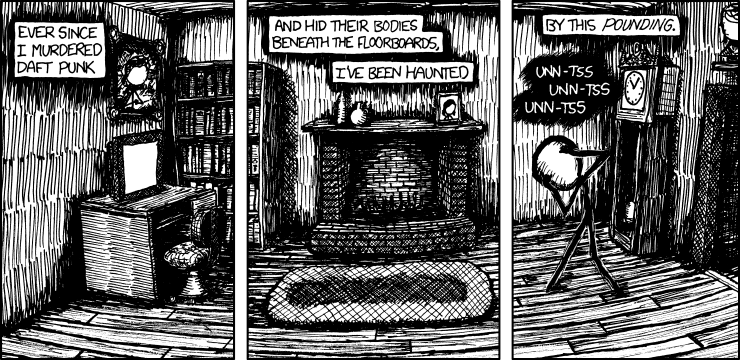
I found this webcomic to be very relative to that of Maus I: My Father Bleeds History, in the ways the panels are constructed and illustrated. Of course within the story of Maus there are no stick figures as characters, or humorous talk about bands, but rather was drawn in a way that struck me as reminiscent to that of Maus. The lines used within this webcomic gave me that dark and somewhat eerie feeling just like in many panels of the graphic novel Maus. Everything within the panels is dark and extremely detailed with the added contour to the items within the frames. Just looking at the depth and boldness of the fire place gives me an uneasy feeling, like that of loneliness and anxiety. I know many might not understand my reasoning behind this, but it is the very first thing I felt while looking at this.
Maus: The Soundtrack
Personally, sometimes I can’t work without some music in the background. According to this snippet from NPR’s Intersections, Art Spiegelman also needed a little sound to inspire him while creating Maus. Along with the recordings of his father Vladek, Spiegelman also tuned in to the Comedy Harmonics (read the article), both of which you can listen to on the site. I had some trouble playing the recordings directly beneath the article, but the ones at the top of the page are interesting when you put them into context. The clip from Vladek is transposed almost verbatim into the comic, which I felt really made it pop in terms of authenticity.
If you look around the sight (i.e. just below the article and somewhere to the right) there are also some links (some broken) to articles about Maus from NPR and other sites.
Inglourious Basterds
This isn’t my week for a Link post, but Here is the link to PART of the Inglourious Basterds scene that Michael was talking about in class, for everyone who hasn’t seen this amazing film. This isn’t the whole scene, but you can see that it definitely parallels some of the themes brought up in today’s class. When I saw this movie in the cinema for the first time, I instantly thought of Maus also.
Pathemata Mathemata
I found it incredibly interesting that during our class discussion today most people who spoke were interpreting the animal imagery of this piece as being an artistic means to segregate different groups of people. I personally looked at the imagery more as a means to mask individuality in order to give this story more of a potent influence. The way that these characters were drawn, with animal heads and human bodies, made it seem to me as if everyone was wearing a mask. It has a permeable effect that allows the reader to feel as if he could have been part of the Holocaust. It personally left me feeling as if this could be the story of my Grandfather, Father, or even my own.
I want to expound further on nberry1’s post specifically focusing on how surviving trauma has influenced both Vladek and Art Spiegelman. I disagree with nberry1’s opinion that “[Vladek] pessimistically mocks the bond [of friendship]” during the first scene of this book. I feel as if Vladek is actually doing his best to teach his son how to survive and what friendship truly means. By saying, “Your friends? You lock them together in a room with no food for a week…THEN you could see what it is, friends!” I interpreted Vladek’s words as a lesson that a horrific instance can bond people together in the strongest way possible; by revealing a person’s true character. In no way am I saying that there were no instances of betrayal, desperation, or selfish panic during the Holocaust but different people survive horrible traumas in diverse ways, including committing some acts of altruism. This is a lesson of a father to his son, a survivor to one who struggles to overcome, that while you must take care of yourself in order to survive, one cannot simply survive on his own.
“Then I slowly realized that your greatest art is the art of survival.” -Line from Death and the King’s Horseman.
Prisoners on the hell planet
I first encountered “Maus” when I was about 11. My family was on vacation and we went to the Anne Frank house in Amsterdam.
I remember being told that this was a completely different type of comic book. It featured real people whose lives had been adapted in an arthropomorphic way.
I didn’t really get that statement but I did read the comic. I am glad I did.
“Maus” is a survivors tale. However, it is a multi-faceted survivors tale. Art Spiegelman is interviewing his father but at the same time he is doing to his best just to ‘survive’ his fathers various neurosis. Art is also trying to survive his mothers suicide, an item he documents in his “Prisoner on the hell planet” comic.
–Funny, the family members of the recently deceased are called “the survivors.”–
What is really great about this comic is how it treats the idea of survival. There is a two page prologue that features Art as a boy skating with his friends. He falls down and his “friends” leave him. He tells his father, who pessimistically mocks the bond– he comments on people confined to a small room with no food and comments on who is a friend in that situation.
The Jews trying to survive in Hitler’s Europe didn’t have friends. Their own people worked as informants and policeman–vladek’s cousin. They sold each other out in hopes of surviving. It really makes you think about what was happening.
How does it feel not to be able to trust your neighbors, your friends, your lovers, etc? How does it feel to be robbed and cheated with no place to go?
“Maus” doesnt try to answer these questions. “Maus” , in all of it’s genius, presents these problems to the reader for them to figure out.
Other graphic media in Maus
I have read Maus before, and one of the first things I noticed that I had not seen before was that the title pages of each chapter have a sort of movie-poster quality to them. Page 15 really made this apparent to me when the backdrop to Spiegelman’s father on an exercise bike is a movie poster for The Sheik, the 1921 movie which the first chapter of Maus takes its title from. The other chapters have similar title pages, each with a different name usually written in a text that reminds one of old adventure movie posters. Later on in Maus, on page 102, Spiegelman reproduces another comic of his inside the page. This mimics the sort of frame story which Maus is: a tale of the author’s father but also of the author himself and his interactions with his father as he reacquaints with him to be told the story.
MAUS First reading
I’ve heard about MAUS before from friends that read it in high school, but I didn’t really know what to think going into it. I really liked how the characters were portrayed as animals. It helps show really how the Jews and Nazis were playing a game of cat and mouse. The Jews running away and hiding as best as they could only to be found eventually by the predator. The Poles being shown as Pigs, I didn’t know what to think of at first, but I suppose you can say how pigs and rats can live in harmony with no problem, just as pigs and cats. What I really liked, though, was how the story is told through the author’s father’s stream of consciousness. How it goes from Holocaust to the father’s house really made the story seem like a first hand account. The way the author portrays his characters also really makes them seem real. His father talks like and has all the mannerisms of an old Jewish man. along with his younger self. As a young bachelor he chooses a richer, duller looking woman over a fun, poor woman.